Category Archive : Guide

cover-how-to-measure-podcast-success(1)

​​When you first set out to measure your podcast success, the mere idea of it might keep you up at night. You compare yourself to other people on social media and get caught in a cycle of shame. My one podcast friend recently hit a million downloads. Why aren’t I there yet? Am I missing some magic secret success ingredient? What does podcast success even look like? Is it a multi-million dollar deal with Spotify?

Chances are, there’s no one “thing” your friend is doing that you aren’t. It’s more likely they have a different audience than you, and they likely have different podcast goals.

I recently chatted with a business friend on her podcast, She Built This, about this exact topic, and I knew I had to make sure you could access it. So in this post, I’m going to help you shake off that pesky comparisonitis and start feeling excited about the podcast success you’ve had so far.

Listen to me talk through all these and more on the She Built This Podcast.

I’m breaking down 3 strategies to measure podcast success without feeling stressed out or overwhelmed because you don’t know where to start.

Make sure you read to the end because I’ve got a bonus strategy that is essential for measuring your podcast success!

3 Surprisingly Powerful Ways to Measure Podcast Success

One question that comes up for our clients regularly is this: how can I measure podcast success?

If you do a quick google on the topic, you’ll find everything from looking at your downloads to seeing your social media engagement. Those numbers can help sometimes, but there is so much more you have to take into account when you are trying to measure your own podcast success.

#1. Forget about the Podcast Downloads

If you want to have a better understanding of measuring your podcast success, you have to get past the arbitrary download numbers.

This is #1 on the list because it’s the thing almost all podcasters get caught up on. They see the downloads and decide that those are the numbers that only matter.

via GIPHY

While it’s essential to have a pulse on the download numbers, that only tells us part of the story. As podcasters (and business owners), there’s more that we should be tracking.

When you are trying to measure your podcast success by looking only at the downloads, it can lead to giving up on your podcast before you’ve really had a chance to get it off the ground.

Did you know 90% of podcasters don’t make it to 25 episodes? My goal with all the content I create and the services we offer at Galati Media is to support you so that you don’t just become another statistic.

Instead, let’s look at the numbers for what they can actually tell us. Your downloads tells you how many people have streamed or downloaded your show. 

Note: Depending on the podcast listening app, it might actually consider someone following your show as downloading ALL your episodes. That’s why the more episodes you create, the easier it is to get more significant download numbers.

So when you look at your download numbers, all you see is that someone decided to take a 2-second chance on your show.

Instead of looking at just the downloads, we should be looking at all the possible information available to us.

For example, we were looking over a client’s statistics during our monthly strategy session (every client gets them) and saw that her guest episodes were getting about half the downloads as her solo episodes. She asked if it was worth it to stop doing guest episodes entirely. 

My response was this: well, is your goal in having that guest about connecting with the guest or about giving your audience content they want? 

This gave the client another perspective and she realized that her goal was actually about the connection, not about the download numbers.

RELATED POST: Creating and Keeping Podcast Goals

#2. Always Go Back To Your Goals

Regardless of what your goals are, reviewing your podcast statistics is always smart. If you take the time to get clear on your goal first, though, it helps you decide which information is actually important.

So let’s break down a few popular podcast goals and how we can actually measure the podcast success based on the specific goal.

Potential Goal #1 – Get more leads from your podcast

This is one of my favorite goals and is something I specialize in. You can hear all my thoughts about the topic on my podcast, Listeners to Leads. 

If your goal is to get more leads from your podcast, you’ll want to have a few key things to track this. Add a How did you find me section to your contact form so you can see how many leads are coming from your show. 

Another thing you’ll want to track is your links. You can use a bit.ly to easily show how many podcast listeners are clicking on certain links. That tells you which services listed in your show notes are getting traction.

You’ll also want to ensure that the content on your show is directing people to actually work with you. Seems like a no-brainer, but a lot of podcasters forget to let their audience know how they can buy from them.

Potential Goal #2 – Interview potential leads or collaborators

This goal is something that doesn’t take a ton of effort to track. You’ll simply note how many podcast guests turned into leads or collaborators. 

If you do go this route, you’ll want to ensure you are following ethical strategies and not hounding guests to become clients. That never feels good. If they can use your support, you can offer it; but I don’t think your podcast should turn into an end-to-end funnel.

RELATED PODCAST EPISODE: Finding Where Your Podcast Fits in Your Funnel with Nicole Hesse

Potential Goal #3 – Show up as an expert or thought leader

With the goal of showing up as a thought leader, you’ll want to dive deep into your download numbers. And I’m not just talking about how many people listened to each episode. 

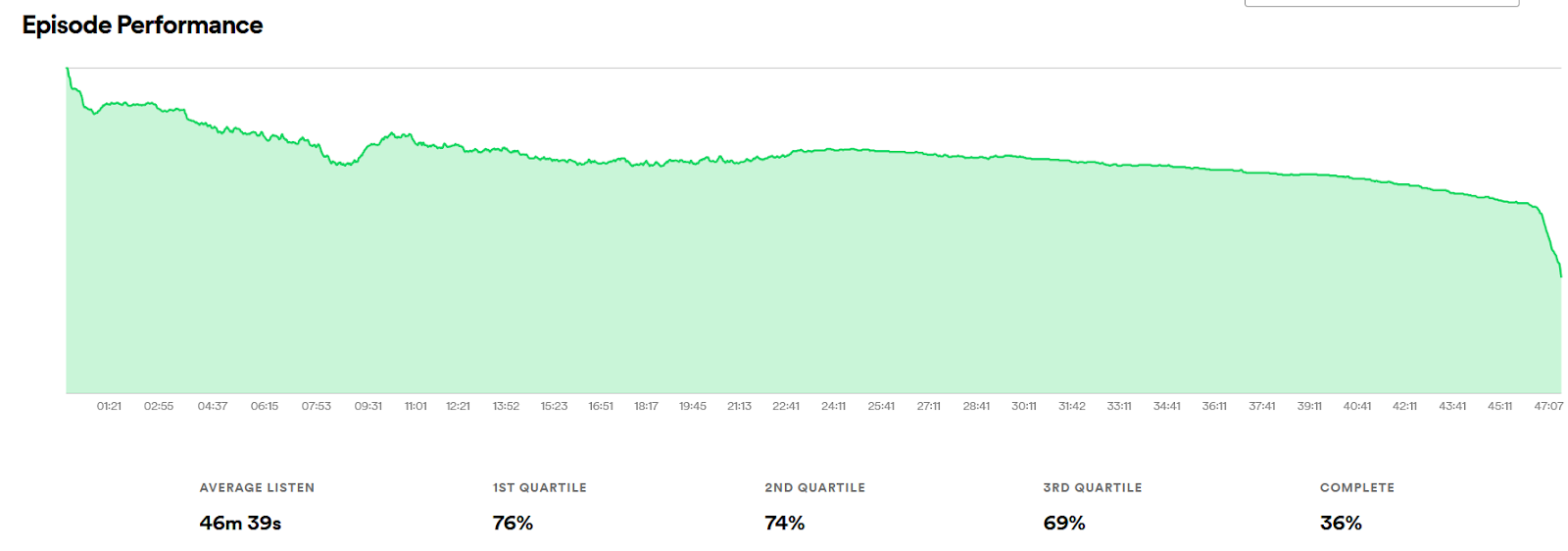
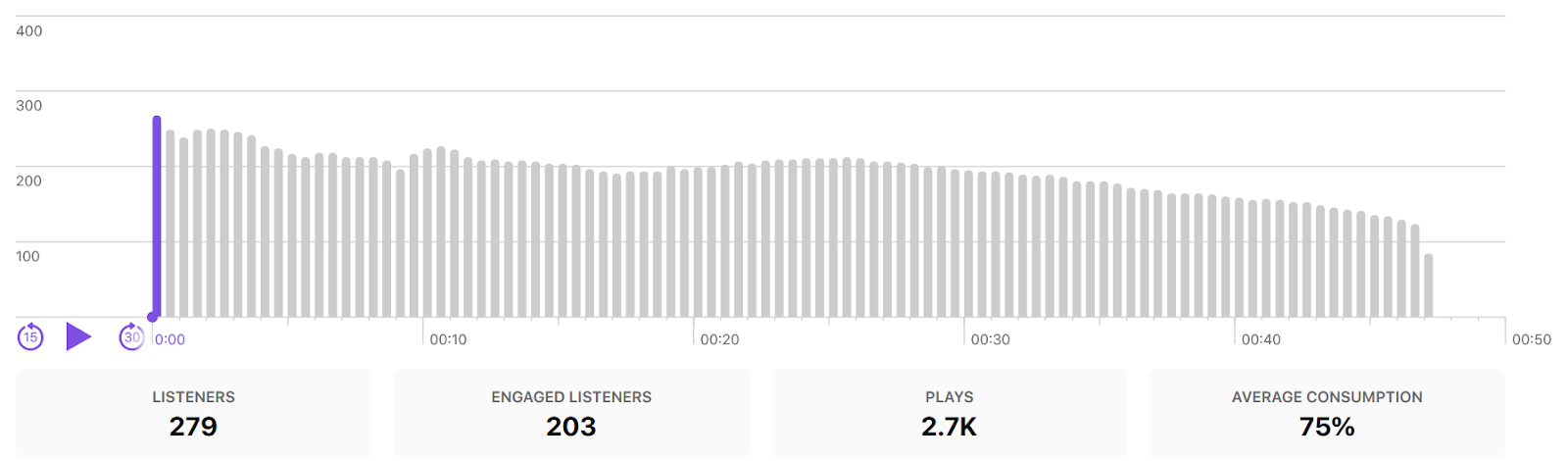
Here you want to know how much of an episode do people listen to. On Spotify, this is called the listener retention and on Apple Podcast, it’s call your average consumption. It doesn’t matter what it’s called. Put simply, it’s how much of an episode is consumed by listeners, on average.

This is important for the thought leadership goal because it can easily show you where most of your audience drops off. 

Spotify Episode Performance
Spotify Episode Performance

Apple Podcast Average Consumption
Apple Podcast Average Consumption

Both of these graphics above show the listener behavior on both Apple Podcast and Spotify for the same episode.

Looking this over, I can tell this solo episode was very popular. You might think that most listeners only listening to about 69% – 75% is terrible. But what you probably don’t know is that from the information I’ve gathered with our clients, most podcast episodes get about 50%-60% completion. 

That means that, on average, your listener will only listen to about half of your episode. But don’t let that discourage you! If you are using your podcast to be a thought leader, you’ll want your solo episode to do better than 60%, and you’ll want to get some interactions from your audience that they are taking action on the things talked about.

Potential Goal #4 – Make an impact with your content

If your goal is to make an impact, then the download numbers may or may not be important to you. It depends on what you believe is impact.

Your impact could be toward your guests. Then the downloads don’t matter. 

Your impact could be that you want to have a certain number of people listening to your message. Then your downloads are definitely going to matter to you.

Or your impact could potentially be that you want to turn those listeners into leads and make an impact on clients that way. Then you will need to look at more than just your download numbers.

These are only a few of the goals you can have around your podcast. So go ahead and take a few moments to decide what your podcast goals actually are so you can see if your show is successful or if you need to make tweaks.

Pro tip: You don’t have to pick just one goal. You can decide that you have two or three goals tied to your podcast.

#3. Get Support When You Need It

It’s easy to get stuck. 

Maybe you’re putting the time in but still unable to reach your podcast goals. Maybe you’re struggling to make your podcast work the way you want it to.

It’s one thing to get stuck temporarily and feel confused about what you should be doing. But when it goes on too long, you can fall into a rut and lose your motivation to even keep the show going.

That’s what happened with my friend, Emily. She was struggling with how her show of over 200 episodes. While hitting that podcast milestone is a big deal, she wanted to focus her efforts on using her podcast to bring in more leads to her business.

After working through her statistics, listener feedback, and more, my recommendation was to start a new podcast that would have content that her potential clients would be attracted to. Her first podcast was focused too much on all the business owners, not the ones who would want her copywriting services.

So she put in the work…and in less than ten episodes, she got her first client from her new podcast! 

If you’re struggling to understand your statistics or measure your podcast success, it may be time to reach out to a podcast strategist like me for guidance and clarity.

There are many ways that a podcast strategist can help:

  • Creating clarity around your podcast goals
  • Giving you tips, tricks, and strategies to achieve those goals
  • Measuring (and celebrating) your podcast success

If you’d like to work with me, click here to book a strategy session.

Bonus! Listen to the Podcast!

It’s easy to feel overwhelmed by all the work you’ve done for you podcast and understanding your numbers, so I have some resources to make it easier.

Over on the Listeners to Leads podcast, I have plenty of episodes where my guests and I talk about understanding your numbers and which numbers you should actually be tracking. Here are a few of my favorites: 

Podcast Stats: What do they mean and how to measure success

Tracking and Understanding your Podcast Metrics with Danielle Hayden

Using Podcast Listening Statistics to Make Better Decisions

Wrapping it up

I hope this post showed you that every step you take is a HUGE win and no one can take that away from you.

So raise your hand, reach around and pat yourself on the back! Figuring out how to measure podcast success doesn’t come easy, but you’re doing it!

Every step is getting you closer to your finish line. And at the end of the day, that’s all that really matters.

So now I want to turn it over to you. Which of these strategies will you be trying first?  

Are you going to book a strategy session? Or listen to the podcast?

Let me know by leaving a comment below!


monetize-a-podcast

Fun fact: Less than 2% of all podcasters with more than 5,000 listeners per episode are making money from their podcast! 

We know, we know, that fact wasn’t fun at all… because as you can see, only a very small percentage of podcasters make money from podcasting. 

Here’s a sunnier statistic: Of the podcasters we work with at Galati Media, over 90% are monetizing their podcasts and bringing money back into their own businesses. 

It’s really important to us as a podcast production company to ensure that the podcasters we work with are getting the results they need and a return on their investment with us.

How Can I Make Money from My Podcast? 

How to Monetize a Podcast Right Away!

In this blog, we share eight ways to monetize a podcast by choosing the best method for you and your listenership. 

It’s important to remember that making money (we like to say cash money dollars) with your podcast is often a long game and takes a long-term strategy and approach. Buyers are often at different stages in the journey and could be symptom-aware, problem-aware, or solution aware and it’s important to speak to them in each of these phases. You also have to understand that there are different types of buyers: early adopters, late adopters, laggards, and every stage in between! Some people take time to make a decision to spend money with you and others sign on the line right away. 

Podcasting is a great way to show up for the different types of buyers and speak to them where they are in the buying journey.

Podcast episodes we recommend that go hand in hand with this blog: 

Listeners to Leads Episode 26) How to Monetize Any Podcast

Listeners to Leads Episode 29) How to Monetize Your Podcast By Selling Your Own Services and Products 

Your Answer to, “How Can I Make Money from My Podcast?” 

8 Ways to Consider Monetizing Your Show

How to Monetize a Podcast with Affiliate Marketing

Affiliate marketing is something we often use in our show Listeners to Leads and it makes a lot of sense for business owners who use apps, services, programs, and other resources to grow their businesses that they can stand behind. 

For example, we regularly guide people to Buzzsprout as a podcast hosting platform. We love Buzzsprout because of its user experience, customer service, and intuitive back end. Because we recommend Buzzsprout so often, we’ve become affiliate marketers and promote it in our podcast episodes with an affiliate link in the show notes.  


Two reminders with affiliate marketing: 

  • You have to inform your audience up front that you’re an affiliate for whatever you’re promoting and disclose that you get a kickback from sharing this resource or tool. 
  • It’s best not to rely on affiliate marketing as the sole way of monetizing your podcast, as it’s best as a supplemental monetization tool 

How to Monetize a Podcast with Sponsors and Advertisers 

You’ve probably seen (and heard) this a lot in the podcasting space. We discuss this method with a few of our clients looking to monetize their show beyond just promoting their own servies and products. One thing to keep in mind is that with sponsors and affiliates, is that many require a substantial amount of downloads (usually about 10,000 per month) to be considered. 

You also need to evaluate whether or not it’s a good fit for your audience. If you’re doing a podcast on baking, does it make sense to run ads on mattresses? 

Look at what’s in alignment with your listeners and a best fit for your brand when choosing sponsors and advertisers. 

Interested in joining a Podcast Network? Learn more about them in this blog post.

monetize-a-podcast

How to Monetize a Podcast with Donations 

One way to monetize your podcast is through donations. This could be anything from having your listeners contribute through Venmo or PayPal. Some people will invite their listeners to “buy them a coffee”. This method is a good choice for community-building podcasts who have a solid listenership of people who love them and want to support them by sending them something nice. 

How to Monetize a Podcast with Premium Content 

This method of monetization has been increasing in popularity over the past several years, and there are a few ways to go about it. You could offer exclusive bonus episodes or early releases that live behind a paywall or create supplementary resources for episodes such as downloads, PDF’s, checklists, and worksheets. There’s even an opportunity here to create a membership around the podcast where they get access to exclusive, more in-depth content with a monthly membership. 

What can you add onto your podcast as a bonus that comes at a cost to access? 

How to Monetize a Podcast with Products and Merch 

Who doesn’t love a good piece of merch!? T-shirts, mugs, tote bags, and notebooks can all be customized to have your show logo or a catchphrase on them for purchase to create community around your show and to help promote your show. 

Think of what might make sense for your listeners and related to your topic and consider how you can create a tangible product around it. 

How to Monetize a Podcast with Your Book 

If you’re an author, you can use your podcast to have people buy your book. Maybe you even offer listeners a free code through your show and they only have to pay shipping and handling. Or they get the first chapter FREE and then a promo code to buy the whole book through your show. 

Authors have a lot of opportunities to make money through podcasting by offering content they’ve already created! 

How to Monetize a Podcast by Landing Speaking Gigs 

Another way to make money with your podcast is by using your show to land speaking gigs. If you want to be a speaker and get on more virtual and live stages, a podcast is a great way to express your thought leadership to show up as the expert in your industry. 

You can use your show to express your unique ideas and stories that you can then turn into speaking opportunities.

How to Monetize a Podcast by Selling Your Own Services and Products 

This is obviously our favorite way to monetize your show. Whether you’re offering 1:1 services, products, courses, or consulting, you can make money with your podcast by selling what you provide! 

If you have something to sell and you want to monetize your podcast in this way, you have to make sure you’re talking about it! Make sure you’re clearly reminding people and letting them know how they can work on you 1:1 or in a group setting. Give them consistent and clear next steps. 

You have to continuously remind them of what you offer and how they can take action to working with you. 

If this sounds right up your alley and you want to know how to monetize your podcast, you’re definitely going to want to give Episode 29 of Listeners to Leads a listen) How to Monetize Your Podcast by Selling Your Own Services and Products. 

One-size doesn’t fit all when it comes to how to monetize your podcast! 

There are so many ways to make money from your podcast, the key is to find one that works for you and get confident in your strategy so you can turn your podcast into a sales funnel that brings you in leads, and cash money dollars. 

At Galati Media, we know the internet is riddled with podcast strategies. We also know how to focus on the one that’s right and most effective for YOU. We provide you with realistic, straightforward recommendations that will help you to increase listener engagement and maximize the results with your podcast based on your goals for your business and audience.

  • We offer podcast strategy without the fluff, so your content can make a difference in the lives of your listeners! 
  • Our 60-minute podcast audits include a deep dive into your podcasting goals and how effectively you’re achieving them. We provide recommendations around discoverability, artwork, descriptions, episode titles, marketing, your podcast website, and more! You receive a fully prepared report of our findings, including recommendations to increase the success of your podcast. 
  • We help to answer any podcast-related questions you may have and give you clear steps forward!

Book a Strategy Call 


How to Write Show Notes for a Podcast

Podcast Show Notes Template and Examples

Whether you’re producing an audio or video podcast (or both), it’s important to ensure that in addition to providing great content and quality, you also take time to focus on the show notes for your podcast for several reasons. This blog will show you the value of well-thought podcast show notes and how to write show notes for a podcast by providing you with clear examples and templates of show notes for your podcast. 

Why Do Your Podcast Show Notes Matter? 

Podcast show notes serve multiple purposes! They help your audience find and connect with you, your guest, and the books, products, materials, and resources shared in the episode. They also help new listeners discover your content, and improve your ranking on search engines and podcast listening platforms. 

Show notes help show a listener understand what’s in store for them in a particular episode and what topics you’re covering in the conversation. They can help pique listener’s interest and keep them excited for what’s coming next!

Show notes are also a great way to recap or highlight any points in the conversation you want to be sure your listeners remember including data or stats, audio highlights, quotes, and more! 

Listen to the podcast episode about The #1 Way to Grow Your Podcast.

What Exactly ARE Podcast Show Notes? 

When we’re talking about podcast show notes, we’re not talking about transcriptions of your episodes or a blog post of your episode (Yet! But we’ll get to that). We’re going to start by giving you podcast show note examples for the podcast platform itself and then we’ll touch back on blogs and transcriptions because those have a seat at the table in this conversation too! 

Podcast show notes are what you see in your podcast player when you expand into an episode and look like this: 

Example AExample B

They are a summary of your episode, detailing the main takeaways, sharing your guest bio and any relevant links, and anything else you need to pull from the episode for listeners to access with a single click. 

Step-by-Step How to Write Show Notes for a Podcast with Our Simple Template (and examples): 

{Intro Sentence} This week, episode XX of {PODCAST NAME} Podcast is about {Main Topic}! 

Example: This week, Episode 97 of the Listeners to Leads podcast is about SEO and Your Podcast

{INSERT FREEBIE OR LOW PRODUCT OFFER}

Example: Download our Simple Template for Podcast Show Notes! 

In this episode of {PODCAST NAME}Podcast, {GUEST NAME} shares the importance of {TOPIC 1} and actionable steps you can take right now to {TOPIC 2}. 

Example: In this episode of Listener’s to Leads, Erin Ollila shares the importance of having your podcast show notes on a blog and capturing visibility through keywords. 

Some of the talking points {MY GUEST AND} I go over in this episode include:

  • TALKING POINT 1
  • TALKING POINT 2
  • TALKING POINT 3
  • TALKING POINT 4

Example: Some of the talking points Erin and I go over in this episode include: 

* Actual Talking Point One

* Actual Talking Point One

* Actual Talking Point One

* Actual Talking Point One

{Closing Statement} 

Thank you for listening! Be sure to tune in to all the episodes to receive tons of practical tips on {MAIN TOPIC ONE} and to hear even more about the points outlined above. If you enjoyed this episode, take a screenshot of the episode to post in your stories and tag me!  And don’t forget to follow, rate, and review the podcast and tell me your key takeaways!

CONNECT WITH {GUEST}:

Include links to each of these for your guest: 

Facebook

Instagram

Freebie

Work with Guest! 

CONNECT WITH {HOST}:

Include links to each of these for your guest: 

Facebook

Instagram

Freebie

Work with Host! 

How to Write Show Notes for a Podcast Beyond the Listening Platform: 

Ideas to Expand Your Podcast Show Notes 

When writing show notes for your podcast, you can follow our example and template above, and you can also think outside the box, especially if you share your podcast on as a blog or Linkedin article as well! Here are some more of our favorite ideas for expanding or adding to your podcast show notes. 

Turn your podcast episode show notes into a blog! 

Many podcast episodes can be turned into a blog for people who may not listen to enjoy, or for listeners who may want another way to digest and access the information. Here’s an example of a Listeners to Leads podcast episode, we turned into a blog -using our show notes as an outline!  

Are Your Podcast Ads Actually Working For You?

The benefits of turning your podcast into a blog include SEO for your website (new listeners and leads anyone!?), increased visibility for those who may not be listeners, and a way for listeners to easily find and refer back to what was discussed in the episode. 

Provide a full, downloadable transcript of the episode. 

In addition to show notes, some podcasters like to make a transcript of episodes available for accessibility or those who might like to read along while they listen. Podcast show notes are usually limited to <4,000 characters, so it can be beneficial to include a link to download transcripts of the episode. You may also want to consider cleaning up the transcripts if you go this route, as many AI transcription services miss some of the human nuances in our language, which can confuse your reader. 

Remember to keep your show notes clear, concise, and consistent, and follow a similar structure and layout with each episode. This is why it’s so helpful to have a podcast show notes template like the one above, which walks you through step-by-step how to write show notes for your podcast. 

Do you have more questions about how to write show notes for your podcast? 

Make sure to check out episode 97 of the Listeners to Leads podcast with Erin Ollila HERE on the importance of having your podcast show notes on a blog for increased visibility through keywords. 

At Galati Media, show notes are one of the many pieces we handle and take off your plate entirely with our full-service podcast management service. 

You don’t have to be an expert in podcasting (or writing show notes, for that matter) to captivate your listeners’ attention, gain leads and speaking gigs, and change the lives of your audience. 


The Basics of Podcast Editing in Audacity

Learn the basics of podcast editing in this comprehensive guide. From choosing the right software to removing unwanted noise, we’ll cover everything you need to know to get started.

Since its start, podcasting has seen massive growth. Edison Research’s Spoken Word Audio Report shows that the U.S. population listens to spoken word audio daily. On average, podcast listeners will listen to around eight shows per week. This leaves room for everyone to be on their audience’s roster. 

With the increasing popularity of podcasting, the expectations of a quality, well-produced show is on the rise. The podcast content itself is undoubtedly the most important aspect but poor audio quality will not only lead leaders to click off the episode but may also lessen the host’s professionalism and trustworthiness. While we can expect podcast quality to improve over the course of a show’s lifetime, it is important to get the hang of it quickly to increase potential listenership. A well-produced podcast is a sign that the host takes their content seriously and wants to provide a well-rounded experience for their listeners. 

With anything, you can get incredibly granular when it comes to editing techniques and I’m sure we’ll expand on that in the future. Today my goal is to show you everything you need to know the basics of podcast editing from start to finish in a simple, tangible, and easy to understand framework. 

Why Is Podcast Quality So Important?

The Basics of Podcast Editing

In this guide, we will walk through the following steps:

  1. Preparing for Editing
  2. Basic Podcast Editing Techniques
  3. Additional Editing Techniques 
  4. Finalizing Your Podcast Episode 

Preparing for Editing

In culinary terms, ‘mise en place’, a French phrase meaning “putting in place” refers to the setup required before cooking. This may include familiarizing themselves with the recipe, collecting tools, gathering ingredients, and completing basic prep work. Now, you may be wondering what cooking has to do with editing a podcast but it is the preparation that we really want to focus on here. Ask any chef and they will stress the importance of mise en place for a successful recipe execution. 

Simply put, just like a chef needs to know their recipe and organize their ingredients, you’ll want to organize your files and get familiar with the audio you’re working with. This pre-editing phase is just as important as the editing itself when we are looking at the basics of podcast editing.

Creating a Quality Podcast

Organizing Your Files

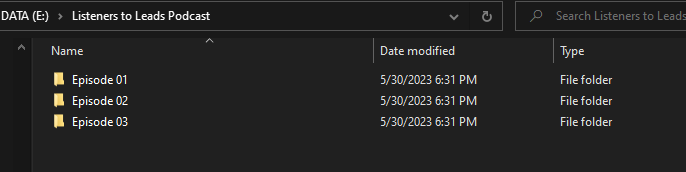
Before you begin editing, it is important to have and maintain a well-organized folder structure. You’ll thank yourself later on when don’t have to backtrack and sort your increasing collection of files. 

I find it works best to have separate folders for each of the clients I work with and subfolders within those for each new episode. This way, if there are multiple versions of the episode, you can quickly and easily find the most recent version. 

PRO TIP: When labeling your files, it is best practice to label the file by podcast name (or abbreviation), episode number, and version number. Not only will this avoid confusion when searching for the most up-to-date version, the chances of you pulling and uploading an incorrect file drastically decrease. 

To be extra safe, I’ve gotten into the habit of saving my files to an external hard drive and/or an online file hosting service such as Google Drive or Dropbox. 

Understanding Your Recording

One of the first steps to editing is understanding the piece of content you’re working with. You’ll want to start by spot-checking your audio and making a note of any background noises, tech glitches, or other problematic areas so you know how best to repair and edit. 

There is a handful of repair software at different price points including Izotope RX, SpectraLayers, Acoustica, and others that can help you repair the quality of the audio before getting into the nitty gritty of editing. 

Remember, while there is a lot that can be repaired in post-production, the software is not magic and cannot fix everything. It’s important to first and foremost record (or have the host record) in an optimal environment. 

For more information on improving the audio quality of your podcast, listen to episode 34 of the Listeners to Leads Podcast: Tips for Better Podcast Audio Quality with Lisa Zawrotny. 

Basic Editing Techniques

Once you know what you’re working with, have prepared your mise en place, and are ready to edit, you’ll want to import your audio into your editing software of choice. I personally use Audacity as it is a free, user-friendly option, but feel free to use the software you like best. 

Other popular editing software includes Garage Band (for Mac), Descript, and Adobe Audition. 

As you get into the groove of editing, you may be able to do all (or most) of your editing in one session but if you’re just starting out, I suggest taking a few passes on the episode focusing on different areas each time. The two main areas you’ll want to focus on are editing for context and editing for clarity and cleanliness. It is totally up to you which order you decide to edit in. The most important thing is finding a workflow that works best for you. 

Editing for Context

Editing for context is a matter of removing tangents that do not provide value to the overall topic, incorrect information that has since been fact-checked, and cutting any dialogue that may allude to past events that are no longer relevant to the time of posting.

Whether it be to educate or entertain the listener, each podcast episode has a purpose. While you’re editing it is best to always consider what information or bits of conversation are going to be valuable to the listener and feed into the overall storyline that the episode is trying to accomplish. 

Editing for Clarity and Cleanliness

Once you’ve cut the episode down to the most valuable pieces of content, it’s time to clean up the episode to provide an overall positive listening experience. 

Enhancing Audio Quality – Two of the basic tools you may use for every podcast episode you work with to enhance the overall quality of your audio is the noise reduction tool and the compression tool.

Compression – You’ll use the compression tool when your piece of audio is filled with peaks and dips in audio to achieve consistency in volume across the track. You may use this on the entirety of the track or just in select areas that need a little more help to even out the noise. 

Noise Reduction – Noise reduction is exactly what it sounds like. This tool removes unwanted background noise that may be appearing on your track. Say there’s a lawn mower or a fan running in the background of your podcast episode, the noise reduction tool will let you select an area with the problematic noise and either remove it completely or lessen the harshness of the noise on your track. 

Removing Unwanted Sections 

Every piece of content you work with will need some work to clean up things like long pauses, heavy breaths, filler worlds, and misspeaks. While you may not notice these things when having a natural conversation with someone, I guarantee you notice when your favorite podcast host stumbles over their words or cannot stop saying ‘um’ between every thought. When in doubt ask yourself, “Will this be distracting to the listener?” If so, it is best to remove it. 

There are a couple of techniques you can use to remove unwanted sections of audio. Either you can select and cut or delete the entire section or you can highlight the area you want to get rid of and silence it. What I choose depends on where and how long I want the pause in the dialogue to be. 

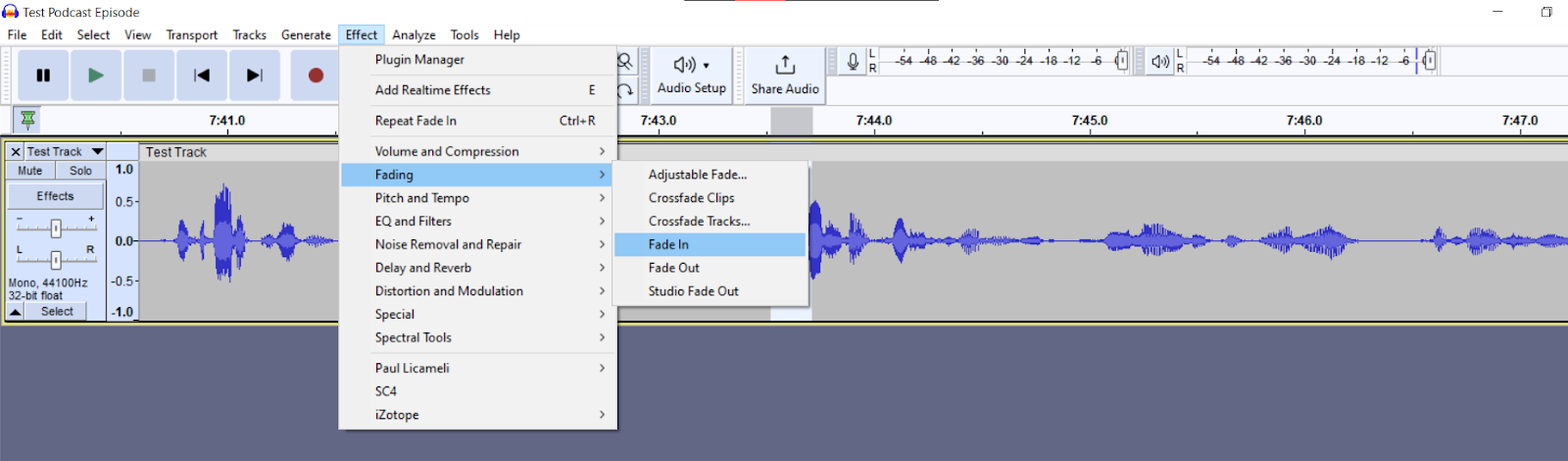
PRO TIP: You may notice when you’re cutting out unwanted sections that the areas that you clipped are not as smooth as you would like. To fix this you can use the fade tool to smooth out any of these areas for a seamless transition.  

While the fade in and fade out tools do exactly what you’d imagine, in some situations you may also use the crossfade tool. With this tool, you can select two clips and have one fade out as the other fades in, simultaneously. 

Additional Editing Techniques

While the basic podcast editing techniques can be very supportive in editing your podcast, there are a few more elements that I believe are important to have a well-rounded and cohesive show. 

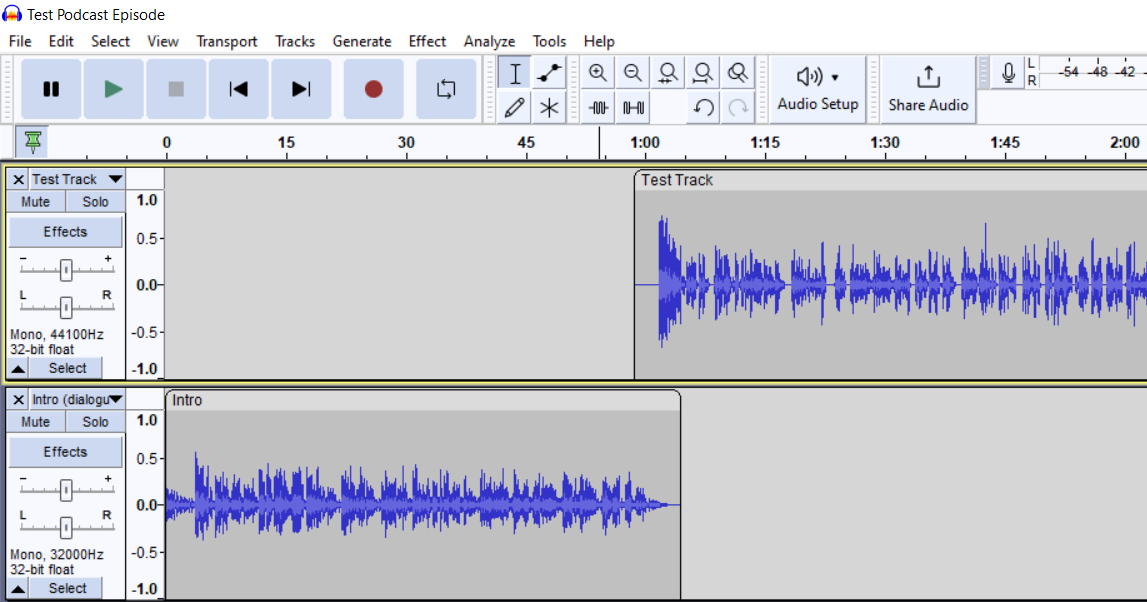
Adding in the intro and outro clips

Most, if not all podcasts will have an intro and outro that sets the tone for the podcast’s overall brand. The intro tells your listeners what you’re about and hooks them into sticking around to listen to the content of the episode while the outro likely has a call to action (join the community, review the podcast, find the host on social media, etc.) and thanks the listener for tuning in. 

If you don’t already have an intro or outro you are currently working with, you can find great free or low-cost royalty-free music at sites like Neosounds, Soundstripe, Audio Jungle, etc. You want your intro, outro, and music to be a reflection of your brand and how you want your listeners to feel when tuning in. 

For Example, If you have a true crime podcast, you might consider a serious, tense, and somewhat spooky music clip while if you have a health and wellness-based podcast, you might look for something more playful, joyful, and inspiring.

When you import your intro or outro segments, you’ll want to work with them on a separate audio track. While most software automatically imports the audio onto a new track, you may have to manually add an additional track on others. When you’re working on separate tracks, you can easily overlap the end of the music from the intro into the beginning of the podcast episode for a smooth transition into the content. 

Incorporating Transition Sounds & Sound Effects

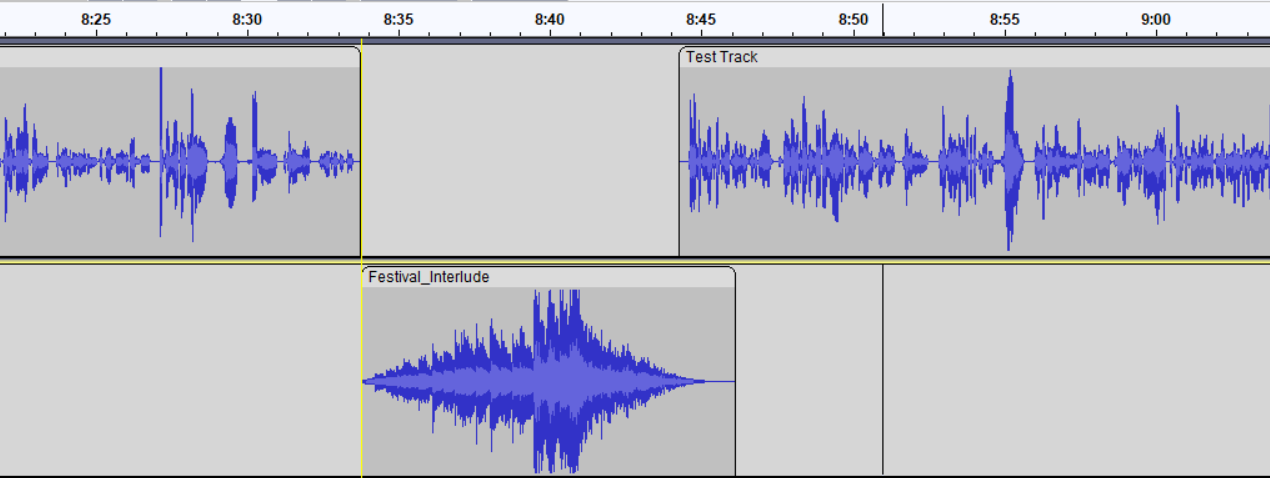
While transition sounds and sound effects are not as common as some other audio elements and really depend on the genre of your podcast, I felt it was important and worth noting. Adding clips of music or sound effects to your episode can help add to the atmosphere of the storyline or break up the episode into different segments. 

Similar to selecting the intro and outro music, when selecting audio clips to add to your podcast episode, you’ll want to make sure the sound you select is royalty-free. You can find a variety of stingers (short pieces of music, often lasting no more than 5 seconds) to use as transition sounds. 

To add a transition effect, import the file onto a separate track and drag it into its placement. You may need to adjust the volume of the audio and use the fade tool for a smooth transition. Be sure to overlap the transition sound with your spoken content for a seamless flow.

Finalizing Your Podcast Episode

Review & Revisions

After your editing is complete, it is time to review and proof-listen to the episode. Listen through one more time to be sure you made all of the necessary edits and didn’t leave anything undone. This may be the time you write the episode’s show notes and pull out audio clips or quotes that can be repurposed. 

PRO TIP: Repurposing your podcast content is an incredibly valuable way to ensure the time and effort you put into your content stretches further and reaches more people in different ways.

Check out these podcast episodes on repurposing your content:

Three Ways to Repurpose Podcast Content

14 Ways to Repurpose Your Podcast Content 

Repurposing Past Podcast Content Using SEO Strategy with Erin Ollila

Exporting

Once you’ve reviewed and made the necessary revisions to the episode, it is time to export! Be sure to check into which format your hosting platform requires. If you use a hosting platform like Buzzprout, export your episode as a .WAV file as Buzzsprout will automatically convert the file into the correct format. Hosting platforms like Anchor require your file to be exported as an MP3. 

*The difference between a .WAV and MP3 is the file size. MP3 files are compressed into a smaller sized audio file while WAV files are uncompressed and much larger. 

Final Touches

The last step to finalizing your podcast episode is adjusting the loudness of your episode. This is important because, as mentioned at the top of this blog, listeners are constantly switching between shows and shouldn’t have to adjust their volume every time they play a new episode or switch to a different podcast. By adjusting your loudness to the podcast standard, you are also proving consistency which is incredibly important to listeners. 

The standard LUFS (loudness units relative to full scale) for podcasts is between -16 LUFS and -20 LUFS

*You can either adjust this in your editing software or use a tool like Auphonic for post-production finishing touches. 

Like anything, there is a learning curve that comes with the basics of podcast editing. Use this article as your starting point and begin applying new techniques as you grow and get more comfortable. What feels like a step-by-step procedural process now will become second nature over time. 

The future of podcasting is now! So whether you have a podcast of your own or edit for someone else, there is so much opportunity for growth in this industry. 

Check back in on our resources page for additional tutorials and information to improve upon your skills. 


Eight top podcast hosting platforms

At Galati Media, we see a lot of podcasters get overwhelmed with all the options out there and love helping clients choose the best podcast hosting platform for their individual needs and podcast goals. 

If you’re scratching your head wondering what a podcast hosting platform IS and why you need one, make sure to go back and read our blog “How to Start a Podcast in 2023 (step-by-step)” which walks you through what a podcast hosting platform is and why you need one. 

In a nutshell, a podcast hosting platform/site is your podcast’s homebase. It’s where you upload and store episodes, and it magically (it’s not actually magic, but sometimes it feels like it) pushes out your new episodes to podcast listening apps right into your listener’s ears. 

Before you just select the cheapest podcast host, check out our recommendations for the eight best podcast hosting platforms and why we chose them. 

Things to Keep in Mind When Choosing the Best Podcast Hosting Platform for You: 

Consider what’s important to you for your podcast. 

  • Do you want to be able to track analytics carefully and dive deep into listener data? Episode 9 of Listeners to Leads: “Podcast Stats: What They Mean and How to Measure Success”
  • What will be the average length of your episodes and the frequency at which you produce a show? 
  • How are you at navigating tech and how important is ease of user experience to you? 
  • What platforms do you want to ensure your show is distributed to? 
  • Will your podcast be a private, paid feed or free for public consumption? 

As we compiled this list, we paid attention to each of these areas to show you the pros and cons of various podcast hosting platforms so you can decide on the best podcast hosting platform for your needs. One of our criteria was also that the platform needed to be aligned with Podcasts 2.0, an initiative to ensure the right of free speech is maintained and allows everyday people to create podcasts. 

As a woman of color owned company, accessibility for all people to create and listen to podcasts is one of our driving values. 

Learn More About Galati Media! 

#1) Buzzsprout: Best Podcast Hosting Platform for Beginners, Hobbyists, and Thought Leaders 

We refer people to Buzzsprout often thanks to its ease of use, great user interface, reasonable pricing, and multiple dynamic ad insertion options. 

What we think makes Buzzsprout the Best Podcast Hosting Platform: 

  • Customize your podcast site with a unique domain name and your branding 
  • Buzzsprout automatically uploads your podcast to some podcast directories with a few simple clicks. 
  • They allow you to upload a transcript for your show 
  • For an additional fee, there are features to help provide better audio quality for your listeners 
  • Free visual soundbite generation
  • Includes a website optimized for hearing-disabled folks.
  • Advanced analytics
  • Affordable pricing tiers 

One of our favorite features of Buzzsprout is the ability to promote your business and offerings with dynamic ad insertions, which are ads anywhere in the show (pre-roll, mid-roll, or post-roll). 

Episode 89 of Listeners to Leads: Are Your Podcast Ads Actually Working For You? 

Buzzsprout is very easy to use and allows you to pay monthly, without commitment so it’s a great way to get started and still have access to in-depth analytics. 

Click HERE to sign up for Buzzsprout!* 

#2) Blubrry: Best for Backend Integration 

Blubrry is well-known for its superior, trusted analytics as one of the first podcasting companies, now serving 150,000+ podcasters with hosting, distribution, stats, and helpful listener insights. It integrates well with the backend of your website, which can be a major benefit for business owners and agencies looking to publish podcast episodes right from their website. Blubrry offers data and statistics that help you make important decisions for your show.

Listeners to Leads Episode 69 “Using Your Podcast Listening Statistics to Make Better Decisions”

Make sure to check out this episode of Listeners to Leads Episode 79 with the founder, Todd Cochrane as he shares his wealth of knowledge into the landscape of podcast and his perspective on The Future of Podcasting! 

#3) Podbean: Best for Podcasters Looking for a Range of Features 

What Podbean does well is offer various plans and price points so that whether you’re just getting started or a seasoned podcast pro, you can access their platform. Features and benefits vary as you move through the tiers, and the free plan does not offer many features. 

They do allow for dynamic ad insertion as well as a customizable podcast website and themes. Some clients we’ve spoken with have said that customer service is not ideal and statistics aren’t as detailed as they’d like. 

Our main beef with Podbean is that they don’t make it easy or intuitive to maximize and customize your podcast website and direct people to your website and social links. 

#4) Red Circle: Best for Growing Brands 

If you’re a podcaster who’s getting thousands of downloads a month and looking to monetize with ads that extend beyond just your own, Red Circle could be the podcast hosting site for you. Red Circle offers a myriad of features including powerful analytics, cross-promotion, and fast support, but one of its highlights is their commitment to helping podcasters monetize their podcasts through: 

  • Brand-to-brand connection 
  • Dynamic ad insertions 
  • Cross-promotion 

Red Circle isn’t for you if you’re looking to use your podcast to promote your own products or services and want your ads to lead to YOU. They also do not have as many tools to provide accessibility and aren’t optimized with all of your audience’s needs in mind. 

Not sure what kind of ads you’ll be sharing? Check out Episode 89 of the Listeners to Leads podcast Are Your Podcast Ads Working for You? 

infographic-best-podcast-hosting-site or best-podcast-hosting-platform

#5) Transistor: Best for Network Owners 

Transistor is a newer podcast hosting platform that’s beneficial for podcasters who want to produce multiple shows and host them on the same site. With Transistor, you can host both public and private podcasts, and include dynamic ads. 

While you can host multiple podcasts on all of the price plans, they offer limited downloads in each tier of their pricing and payments can increase when downloads increase. If you plan to maximize the use of hosting multiple podcasts, and bring in collaborators to your team, Transistor could be a great choice. 

If you’re the everyday average podcaster looking to host just one show, it’s an expensive choice with more features than you might need. 

#6) Libsyn: Best for a Wide Range of Budgets 

You can get started with Libsyn for just $5 a month and upgrade from there to include more features. Libsyn’s been around a long time and is the go-to for many established podcasters; however, despise being budget-friendly, the lower-level tiers have limited features. Overall, the platform isn’t great for beginners who tend to struggle navigating new tech. The user experience makes it challenging to navigate their platform and setting up the analytics properly can require multiple steps. 

Why do we think podcast stats are so important? Listen to episode 9 of Listeners to Leads Podcast Stats: What They Mean and How to Measure Success

#7) Captivate: Best for Monetization 

If you want to use your podcast to make some cash money dollars, you might enjoy this relatively new podcast hosting platform. Captivate helps podcasters make money from their show by offering a private podcast option on every plan, a podcast sponsorship kit PDF, built in calls to action, and tools that help you get sponsors. 

They give you advanced analytics, lots of podcasting resources, and quite a lot of features at every level. The plans are pricier than most (starting at $17/month) and have a cap for the number of downloads. 

#8) Anchor.fm: Best for Beginners 

We have so many thoughts on Anchor.fm, and “free” platforms in general. Here’s a quote from PodMatch’s Alex Sanfilippo from a recent post on LinkedIn: 

“Fellow podcasters: If you don’t pay for a product, you are the product.” 

When you’re using a free podcast hosting platform or just choosing the cheapest podcast host, they’re using you in some type of way to make money as a company. 

A lot of people start out on Anchor because they want to use it and try it for free. Spotify owns Anchor and pressures podcasters to push their shows on Spotify. They also recommend ads that may or may not be aligned with your brand, heavily encouraging you to offer paid membership content or premium content that’s only available to your listeners on Spotify. Anytime you choose to focus on pushing your podcast out on one platform, you shut out a lot of your audience. 

Trust us, we love a subscription model, but it’s not right for everyone and may not be right for you. Check out Listeners to Leads Episode 65 Adding a Subscription Model to Your Podcast to learn more. 

In the case of Anchor.fm, free comes at the cost of pressure and the reminder that you are the product.

One final reminder: You can change podcast hosts down the road, if needed. It’s not difficult, but it’s also a hassle we try to save podcasters from by helping them choose the right platform the first time around. 

To choose the best podcast hosting platform for you, take a look at your individual goals and needs for your podcast and start from there. This crucial first step will help you weigh the pros and cons of each host, so you don’t just hit “Get Started” with the podcast host that has the flashiest website or is the cheapest price. 


Listeners to Leads episodes mentioned in this blog: 

*Buzzsprout affiliate link: www.alesiagalati.com/buzzsprout

This blog post contains affiliate links. That means we may make a small commission on items purchased through links in this post at no extra cost to you!

Looking for personalized 1:1 support to launch your podcast? 

Book a call with us and see if we’re the right fit for your needs!

Is it easy to start a podcast? 10 Things to consider before you take the leap!

Is it “easy” to start a podcast? 

The answer is, “Yes, and…” 

There’s a lot of communication, especially in the online marketing world, that’ll have you convinced that starting a podcast is easy! And equally as much suggesting that “everyone” should have a podcast! 

Starting a podcast doesn’t require a degree in physics or biochemistry (unless that’s what you plan to talk about in your show) but it’s not always as easy as people think to start a podcast. People often come to Galati Media with an idea for a podcast, but don’t know whether or not they should start a podcast, do something else entirely, and how to take action on starting a podcast. 

Here are ten things you should think about and consider before you start your own podcast: 

1. Determine whether or not launching a podcast is right for you! 

Starting a podcast isn’t complicated, but it’s important to keep in mind that it’s not some quick fix or hack for more business and more clients. It’s a long game and requires time at the beginning to build, grow, and plan. 

To determine whether or not starting a podcast is right for you, you first have to ask yourself whether or not you have the capacity to show up regularly for your audience, to engage in the topics you’ll be providing, and to market the show.

Ideally, your show will be produced on a regular basis with a steady stream of valuable content for listeners to learn from and enjoy. Are you able to set aside time and attention to be consistent and show up for your show?

Episode 38 of Listeners to Leads: Is Launching a Podcast Right for You? 

2. Do your market research 

Who are your ideal listeners and audience and is there a need or desire for your content? Is what you want to talk about going to fill a gap in what’s out there as far as resources and education around what you’re sharing? 

Market research involves learning about your listeners and audience as well as looking at other podcasts talking about the same or similar topics. 

If there are endless podcasts out there covering what you want to talk about, it might be an oversaturated topic and too broad. You might think of a different direction, or reconsider. There may be no gap to fill. Conversely, if there are NO podcasts out there talking about what you do, or there are just single episodes, there may not be enough to cover and it might be too niche of a topic. 

If your topic is something you can cover in just one episode, or a single workshop, starting a podcast might not be right for you. 

Another piece of market research is listening to other podcasts and learning what you like and don’t like, how you’ll do it differently or focus on a different niche, and really getting to understand if there’s an audience for your show. 

Episode 22 of Listeners to Leads: The Importance of Market Research 

3. Determine your goals for your podcast

As a podcaster, it’s important to set clear, achievable goals, and treat your podcast like you would any other part of your business so you don’t set yourself up for failure or podfade due to lack of results. 

Your podcast could have goals around building your business through lead generation, supplementing your existing content for additional support, raising awareness, connecting with guests for networking or potential client opportunities, or something else entirely! 

Looking to monetize and make money with your podcast? Make sure to check out our blog “How Can I Make Money from My Podcast” when you’re done with this one! 

Whatever goals you set, you’ll want to make sure that they are SMART: specific, measurable, attainable, realistic, and timely. You also want goals that are relevant to your unique business! 

What do you want your podcast to do for you and your business? Ask yourself what your goals are for your show and get clear on that and it will make starting a podcast (and not getting frustrated) a whole lot easier! 

Episode 44 of Listeners to Leads: Creating and Keeping Podcast SMART Goals

4. Take time to map out your podcast content

We spoke to this a little in the market research paragraph above, but trust us, it bears repeating and needed its own section! Content (and you, of course) are the reason people are listening to your podcast in the first place! 

Approximately 90% of podcasts stop producing before they hit seven episodes. 

There are many reasons why this happened, but one of the most common reasons is because they run out of content. 

Brainstorm your content ideas and be really honest with yourself about whether or not you have enough content within your topic area to keep you excited and engaged as you share consistently. 

Need help coming up with Podcast Content ideas? We have tons of resources from planning and organizing to idea generation here. 

5. Determine Your Format

As you listen to other podcasts, you start to learn what you like and don’t like about how they do their shows in the content they offer, their perspectives and viewpoints, and the format as well. 

There are so many different ways to format and structure your show and the only right way is the way you decide to do it. 

Thinking about the format for your podcast is a crucial step to getting started. Ask yourself if you want: 

  • Formal or informal show
  • Solo episodes (you by yourself) 
  • Guests
  • Co-hosts 
  • Scripted vs. not scripted 

Choosing the format of the episodes will help guide you in how to move forward in starting with your show, plus help you understand better how much time you’ll need to commit to each episode. 

Episode 36 of Listeners to Leads: How to Choose a Podcast Format

6. Consider equipment 

We promise not to get too in the weeds and overwhelm you here. You will need to spend time, prior to starting your show looking at what equipment you need and how much you can afford to spend on what. 

At the very minimum to get started you need, a set of headphones, a quality microphone, recording software or platform, editing software and a podcast host (which we’ll talk about more in a minute!).

How much you’re looking to spend on your show is unique and personal to you and depends where you are in your business, what goals you have for your show, and how much you want to invest initially. 

Will you be outsourcing the many tasks and headaches of editing and producing to a podcast production company or will you be DIY-ing it?

If you’re planning to outsource, we’d love to help you get started considering these questions, and more! 

7. Choose your hosting platform

Choosing a podcast hosting platform isn’t as simple as just picking the cheapest podcast host, there are a lot of factors to consider when looking at what you need in the short term and long term for your show. 

Fortunately, we’re not going to leave you hanging here. Here’s our blog, What’s the Best Podcast Hosting Platform where we highlight eight top podcast hosting platforms to help you decide which is right for you! 

8. Branding and Artwork

Finally, the fun part, right!? Making your podcast pretty and pop visually! 

Unless it’s a hobby podcast, your branding and artwork for your podcast should align with your current business branding. Your podcast is an extension of your brand, so it’s important for the two to be cohesive and work together. 

Plus, if you’re as OCD as us, you’re not going to want clashing colors next to each other on your Instagram feed. 

The visuals you’ll need for your show depends on where you’re sharing episodes and how, but you’ll most likely need visuals for your podcast page/website, individual episodes, cover art (your show’s main graphic), and individual social media graphics for things like quotes and audiograms. 

While podcasts are mainly an audio experience, graphics still play an important role. Graphics are definitely something to think about as it’s crucial to share bold, clear podcast graphics that catch attention and are a reflection of your brand. 

Episode 96 of Listeners to Leads: How to Design Eye-Catching Podcast Graphics with Lauren Felter

9. Create your marketing plan, launch strategy, and assemble your launch team 

The more intentional you are at the beginning, the better. When you start a podcast in a thoughtful, strategic way, it can help your show be more successful from the get go, and save you a lot of frustration! 

You’ll want to think about how you plan to market your show, who to can help you share when it first comes out, and what steps you’ll need to take to share it with the world and get people listening! 

It’s really important to take time now and think about your first few weeks of content so you’re not flying by the seat of your pants when getting started. 

Listeners to Leads Episode 23: How to Create a Podcast Launch Plan

10. You don’t have to do this all alone!

The number one piece podcasters tend to hire out is editing. In addition to editing, there are so many tasks that go into the management and production of a successful podcast. 

Here are some of the things involved in producing a show: 

  • Launching strategy
  • Marketing
  • Editing and audio quality 
  • Guest booking and follow up 
  • Publishing and syndication across podcasting platforms including Apple Podcasts (iTunes), Spotify, Stitcher, Google Play, and other podcast networks and directories
  • Cover art design, promotional graphics, and branding 
  • Creation of show notes
  • Social media posts, blog posts, emails to promote the show 
  • Creation of intros and outros
  • Generating episode transcriptions
  • Repurposing podcast content into video clips, audiograms, and other social media content

The good news is, you don’t need to do any of this alone. At Galati Media, we support you in managing your show from soup-to-nuts, even the stuff not on this list (yes, there’s more!) 

We walk you through these questions prior to getting started, and help guide you in making pivotal decisions for your show. 

When we’re asked, “Is starting a podcast easy?” our answer is a confident, “Yes, if you’ve taken time at the beginning to ask yourself these questions and make a plan! And it’s a whole lot easier with us by your side!” 

Ready to start your podcast?

You’ll want to check out this blog next if so where we walk you through Step-by-Step How to Start a Podcast


The Truth about AI and Podcasting | Listeners to Leads

The 5 AI and Podcasting Tools Used by Podcast Managers 

AI is on the rise as the hottest new productivity tool, but there seems to be conflicting information about how much AI podcast tools can do. On the one hand, Podcast.AI has shared stats saying that AI-powered podcasts have grown 500% in the last year. On the other hand, Google has released a statement saying that content that is clearly written by AI will be considered spam or inaccurate and therefore penalized in search rankings. As podcast managers, we help a lot of podcasters find the right balance between saving time using AI podcast tools and keeping the human elements that your listeners connect to. Here is everything you need to know about using AI for your podcast. 

What Is AI?

AI stands for artificial intelligence. It learns from the data that humans input, including user habits, to make decisions and solve problems. We have been using AI far longer than we realize because it has been behind the scenes in the technology and programs we use. For example, diagnostic tools, smartphones, and self-driving cars all use AI technology. With the hype around Chat GPT, we have become more aware of AI tools and how they can make some tasks more efficient. 

How to Use AI and Podcasting Tools to Save Time 

Before you turn your entire podcast production over to AI podcast tools, it’s important to understand that AI works best in a supporting role. Its strength really lies in gathering and analyzing information, not in tasks that need creativity or discernment. 

So, for example, many podcast editors use AI podcast tools to shortcut simple tasks, like removing “ums” or cleaning up the background noise. This makes the editing process quicker and allows them to focus on the tasks that really benefit from human insight. For example, a human editor can make suggestions on which sections to remove to fit the ideal podcast runtime. 

Another limitation of AI podcast tools is that there have been cases of AI technology returning incorrect results. AI is only as strong as the content or data used to “train” the technology. So if that content is outdated, incorrect, or displays unconscious bias, then the AI tool will return incorrect or misguided information. As podcasters, we have a duty to our listeners to ensure that what we’re saying is accurate, so AI tools are best used for small tasks or when checked and edited by humans. 

The 5 AI Podcast Tools We Use as Podcast Managers 

We use AI podcast tools here at Galati Media to make producing podcast episodes more efficient. Here are some of our favorite AI podcast tools and how we use them: 

Otter. AI

Otter.ai is a transcription tool that creates transcripts of our podcast episodes. It uses voice recognition to show who was speaking in each section, and we’ve had it remember guests who had been on past podcast episodes. Otter.ai can also create a timestamped summary of the conversation, which is really useful for adding those timestamps to the backend of Buzzsprout. 

Buzzsprout

Buzzsprout uses AI to help podcasters find the best place to place their ads. It may not be a huge task, but it is just one other thing that podcasters and podcast producers can take off their plate, and instead of finding the best place to place an ad in the whole podcast episode, you can pick the best of the suggested places to put an ad. 

Chat GPT

Chat GPT works best as an AI podcast tool for brainstorming. It is great to give you ideas or make suggestions if you get stuck. However, I do not recommend using Chat GPT to automate entire tasks. For example, Chat GPT is great for creating a list of podcast content ideas or suggesting alternative title ideas so you can pick the best one. It should be used in conjunction with human insight instead of replacing it. 

HeyFriday.ai

HeyFriday.ai is a new AI podcast tool that we’ve started using to provide title suggestions for our YouTube videos. It can check if our title ideas are SEO-friendly and provide alternative options. We have found that it is not always 100% accurate, so again, this is where you need to use your human insight before posting. 

iZotope RX 9

There are a number of AI podcast tools for audio editing. The one we use is iZotope RX 9, which has different pricing tiers. We love the repair assistant because it cleans up the background noise, pauses, and “ums” really well. Then our podcast editors can make tweaks based on the repaired audio. 

I also chat about the following: 

  • AI-powered podcasts are NOT completely created by AI.
  • Ways to utilize AI in your podcast creation.
  • The AI tools the Galati Media team uses on a regular basis.
  • Why you shouldn’t rely on ChatGPT to write your episodes.

Be sure to tune in to all the episodes to receive tons of practical tips on turning your podcast listeners into leads and to hear even more about the points outlined above. Thank you for listening! If you enjoyed this episode, take a screenshot of the episode to post in your stories and tag me! And don’t forget to follow, rate, and review the podcast and tell me your key takeaways!

Learn more about Listeners to Leads at www.listenerstoleads.com

CONNECT WITH ALESIA GALATI:

Instagram

LinkedIn

Work with Galati Media! 

LINKS MENTIONED:

Podcastle.ai Blog post

Otter.ai

HeyFriday.ai

Descript

Galati Media
Privacy Overview

This website uses cookies so that we can provide you with the best user experience possible. Cookie information is stored in your browser and performs functions such as recognising you when you return to our website and helping our team to understand which sections of the website you find most interesting and useful.