Category Archive : Successful Podcasting Unlocked

Should You Quit Podcasting? 5 Signs It's Time to Re-Evaluate

Should you quit podcasting? Deciding whether to continue or stop your podcast can be a tough call. If you’re considering throwing in the towel, it’s common to feel frustrated, overwhelmed, and maybe even a little guilty. However, choosing to step away from a podcast that no longer serves you is a valid and sometimes necessary decision. 

As podcasters, we pour our hearts into creating engaging audio content for our listeners. However, deciding when it’s time to stop a podcast you’ve been working hard on for months or years can be a difficult choice. In this post, I’ll share my framework for evaluating whether your podcast concept has long-term potential or if it’s time to consider wrapping things up.

The Podcast Failure Rate

It’s no secret that most podcasts have short lifespans. Statistics show that 90% of podcasts don’t make it past 25 episodes (According to the AE Podcast Report). Only 5% reach the 100-episode mark, and under 3% go on to produce 200 or more episodes. This phenomenon is known as the “pod fade rate,” and it highlights the common struggle of maintaining a consistent podcasting journey. While passion alone can initially carry a show, sustained success requires more.

Hitting the Pause Button Without Shame

It’s important to remember that there’s absolutely no shame in deciding that a podcast isn’t the right fit for you anymore. If feelings of guilt or “failure” creep in, remind yourself that your time and energy are valuable resources. Instead of dwelling on what didn’t work, focus on the lessons learned and how to channel your skills into other productive avenues.

It’s easy to feel guilty or like you’ve “failed,” but here’s why you shouldn’t:

  • Your energy is precious: If your podcast is draining more than energizing, that’s a red flag.
  • Skills are transferrable: Podcasting teaches you interviewing, audio editing, marketing, etc. These are valuable elsewhere!
  • Evolution is natural: Your interests or business direction might change, and your content should reflect that.

5 Signs It’s Time to Re-Evaluate Your Podcast

1. Your Goals No Longer Align 

The first step is revisiting your original podcast goals and intentions. Are you still passionate about achieving what you set out to accomplish? For example, if your goal was to generate leads for your business, have you been tracking and analyzing metrics to see if your podcast is delivering results? It’s easy to get sidetracked from our goals as time goes by. Sometimes, taking a step back and re-evaluating what we’re doing is helpful.

Successful podcasts often start with a clear direction and achievable goals. Have you taken the time to set specific, measurable goals for your podcast? Are your content and marketing efforts genuinely aligned with those goals?

2. Consistency is a Major Struggle

You’ll also want to evaluate the effort you’ve put in. Consistency is key for building an audience but life gets busy. Have you been able to commit regular time and energy to your podcast for at least 6 months straight? Or has production become more touch-and-go lately? Understanding your capacity and commitment level is important for determining longevity.

Building a loyal audience demands a reliable publishing schedule. If you find yourself struggling to maintain consistent episode releases, it might be time to re-evaluate your workload and commitments.

3. Life Gets in the Way (and that’s okay!)

Life happens! Sometimes, significant life changes can make it challenging to maintain the same level of podcasting commitment. When major life events occur, it’s okay to shift to a seasonal format, take a temporary hiatus, or reconsider your overall podcasting strategy. Trust your gut. 

Pay attention if you feel burnt out, overwhelmed, or uninspired more often than not. As creators, we know our limits better than anyone. Consistently struggling with motivation, perfectionism or other challenges could be an important signal that it’s time to consider wrapping things up – at least for now.

4. Your Passion Has Fizzled

Your passion and excitement for the podcast topic should also be reassessed. Are you still energized about the material, or has your interest begun to fade? While podcasts can be a powerful platform, they thrive on genuine enthusiasm. 

A lack of enthusiasm will likely show through to listeners over time. If you no longer feel excited about your topics, or if creating episodes feels like a chore, it might be time to reassess whether your heart is still in it. There’s no shame in letting a concept go if your heart is no longer fully in it.

5. Oversaturated Market

Another factor to consider is audience fit. Have you taken the time to carve out a unique niche and perspective, or are you simply regurgitating content already covered by others? Standing out from the crowd in a way that resonates deeply with your target listeners is crucial for long-term engagement. 

Quality over quantity is key. In a crowded media landscape, differentiation will supercharge you. Take stock of your niche – are you offering something unique and valuable that stands out from the crowd? If your podcast feels too similar to others, consider how to reposition your content for maximum impact. Sometimes, that looks like allowing our personality to show through even more.

Quitting or Rebooting? Deciding What’s Right for You

Before pulling the plug entirely, ask yourself if a temporary break or a fresh start might be a better solution. Don’t rush the decision! Ask yourself if a temporary break or a fresh start might be the answer. Consider:

  • Shorter seasons: Gives you a breather with less pressure
  • New format: Solo to interviews, anyone? Revitalize the show
  • Refocus your niche: Is there a better way to truly serve your listeners?

The Bottom Line

It all boils down to an honest assessment of your goals, resources, passion, and the market. Take your time to make the right choice for you! Sometimes, gracefully stepping away paves the way for your next exciting project.

Whether it’s hitting pause, revamping your show, or fully walking away – trust your gut! Your listeners will love you for making a decision that aligns with who you are and what you want. Remember, the journey of creating is never-ending, and a course correction is often the smartest move!

Access the free Podcast Workflow Checklist if you want more support to producing a regular show.

Podcast Workflow Checklist Button

Is It Time for a Podcast Rebrand A Step-by-Step Guide

Have you been podcasting for over a year and feel like your show could use a podcast rebrand? Or maybe you’ve realized your content or audience has evolved in a new direction. Rebranding is a common consideration for podcasters at various stages. However, it’s important to do it right to keep your existing listeners engaged and attract new ones.

In this comprehensive guide, I’ll share everything I’ve learned from successfully rebranding my shows and advising clients through the process. By following these best practices, you can ensure your rebranding efforts succeed.

Is It Time for a Podcast Rebrand? A Step-by-Step Guide

As your podcast evolves, your original branding may feel misaligned. A rebrand can be an exciting revitalization, but it requires careful consideration. Here’s how to know if it’s right for you and how to make it a success:

Know When It’s Time for a Rebrand

The first step is asking yourself some key questions to determine if a rebrand makes sense. 

1. Have you reached at least 25 episodes?

Hitting this milestone is crucial as it helps you better understand your audience and speak confidently on your topic. I consider 25 episodes the minimum before making any major changes. This gives you time to understand your audience and yourself better as a podcaster. Consider if an upcoming milestone episode (like your 100th) makes a good rebrand point.

2. Are major changes needed?

Are you changing everything about the show, or is it simply a minor update? Does it only need fresh visuals/audio? A refresh might be all you need for a new spark.

Tune in to an episode I did with a client about her Podcast Refresh.

3. Will your audience and content shift?

You’ll also want to assess if your content or target audience has significantly shifted from your original focus. A full rebrand with a new name and direction may be needed. But if it’s more of a minor evolution, a simple refresh with updated graphics and minor format tweaks could suffice. Taking the time for self-reflection upfront will guide your rebranding approach.

Important Note: If your show’s content and audience will be completely different, it might be wise to end your current show and launch a brand new one to avoid alienating existing listeners.

You’ve Decided to Podcast Rebrand. Now What?

Treat It Like a New Launch

Once you’ve decided a rebrand is the right move, treating it like an entirely new podcast launch is crucial. Have a strategic plan in place with timelines, promotional campaigns, and goals. Run audience research to define your new positioning and messaging. Podcast market research is always the best first place to start.

Promote your rebrand heavily on social media with behind-the-scenes content, giveaways, and more. This excites your existing listeners and introduces new ones to your refreshed show. Make sure to optimize your new brand for search engines. You can do this by incorporating relevant industry keywords into your podcast title and description. Proper planning sets you up for success.

Download our Podcast Launch Roadmap and use these resources to support your relaunch.

Generate Excitement for Your Podcast Rebrand

Effective communication is critical throughout the entire rebranding process. Let your audience know beforehand that changes are coming and what they can expect. Share your new direction and why you feel it’s a better fit. Be transparent; you may lose some listeners through the shift, but those who stay will be your ideal audience.

Here are some ways to keep the excitement going:

  • Tease the changes: Build anticipation with hints about what’s coming.
  • Behind-the-scenes: Share your rebranding process and decision-making.
  • Sneak Peeks: Offer glimpses of new graphics or theme music.

Get Support From Your Launch Team

I’ve talked endlessly about having a launch “street” team. These are your friends and cheerleaders. The ones you call when something incredible happens in your business. And the ones you call when you need advice.

Enlist loyal listeners and past guests as early ambassadors. Their enthusiasm for your new direction will be contagious. I’ve seen the lack of a launch team make a world of difference for our clients. Don’t skip this part.

Don’t Forget the Tech Updates

Remember the nitty-gritty! Once your new brand assets and first refreshed episode are ready, it’s time to implement the changes fully across all platforms.

You’ll want to check all of the following to ensure you’ve made the proper adjustments:

Hosting Platform: Update your podcast’s title, cover art, and description within your hosting platform (Buzzsprout, Libsyn, etc.)

Podcast Directories: You might need to manually update info on Spotify, Apple Podcasts, etc., to ensure a seamless display of your new branding.

Your Website: Reflect the changes everywhere your show is showcased.

You want listeners to have a seamless experience finding and enjoying your refreshed show. 

Nothing ruins a rebrand like technical glitches, so taking the time for quality control upfront avoids frustration later on.

Prepare for change as you go through a podcast rebrand. It’s natural to potentially lose some followers during a rebrand as you become even more niche-focused. Remember, the ones who stay will be even more invested in your podcast’s new direction.

Revamping your podcast’s branding can be a great way to give it a fresh start and attract new listeners. By being strategic, communicating with your audience, and treating it like a fresh launch, you’ll set yourself up for long-term success.

Have your own podcasting questions? Send them over at Successful Podcasting Unlocked.


Find Your Podcast Frequency Choose Consistency Based on Capacity_ Blog Cover

When choosing a podcast frequency, it’s important to consider what you actually have the capacity to handle. So many podcasters jump in head first with a weekly show, but fizzle out becuase they don’t have the ability to keep up with that type of podcast frequency.

I recently heard the phrase, if the content is king, then consistency is queen. I want to take that a step further today and say that if content is king, and consistency is queen, then your capacity is the key.

As a content creator, you understand the power of consistent, high-quality output. But should your podcast be weekly, bi-weekly, or even monthly? The truth is, there’s no one-size-fits-all answer. The right frequency depends on your unique capacity.

Find Your Podcast Frequency: Choose Consistency Based on Capacity

Content is King, But Consistency is Queen

We’ve all heard the saying that “content is king.” But to keep audiences engaged with your content, you need to show up consistently. This is where the phrase “consistency is queen” comes in. Consistency gives your listeners a reliable cadence to expect new episodes.

But who decides what consistency looks like? 

Sadly, the pressure to be “consistent” can lead podcasters to burn themselves out. I’ve seen many give up after just a few months, unable to keep up with an unrealistic schedule. This is why capacity is so important to consider.

BONUS: Are you consistently tired of being consistent? My friend Emily has a great blog post and podcast episode on the topic. This perspective is from someone who has been consistently showing up as a copywriter and it gives a great overview of content creation as a whole, not just from the podcasting perspective we discuss here.

Define Consistency Based on Your Capacity

Your capacity refers to how much you can reasonably produce and promote given your schedule, resources, and lifestyle. It’s different for everyone. Don’t feel pressured by benchmarks like daily or weekly shows if that’s not sustainable for you.

We often equate consistency with relentless daily output. But true consistency is about the commitment you make to your audience, and your ability to honor it. Here’s how to reframe consistency:

  • Set your own rhythm: If “weekly” is unsustainable, don’t force it. Bi-weekly or monthly, delivered reliably, is far more valuable than sporadic weekly bursts followed by burnout.
  • Quality over quantity: A less frequent release schedule allows you to prioritize depth and polish in each episode, ensuring consistent quality for your listeners.
  • Honesty is key: Be upfront with your audience about your release schedule. Transparency builds trust and manages expectations.

The key is choosing a frequency you know you can maintain long-term based on your capacity. This establishes consistency in a way that doesn’t lead to burnout. You set the expectations for your listeners and yourself.

For example, if you can only commit to one episode every other week, own that schedule. Release your episodes biweekly without fail. This biweekly consistency will serve you and your listeners better than promising a weekly show you can’t deliver on consistently.

How to Know if a Podcast Frequency is Right for You

Now that we’ve defined that consistency that will work for us, we must audit our capacity to see if it’s still working for us. Life happens. Things shift. And that means that our ability to show up consistently will have an effect on our podcast frequency.

Regularly re-evaluate your schedule with these questions:

Am I resentful of my podcast? This signals burnout. It might be time to scale back temporarily or reassess how you produce content.

Am I sacrificing other important areas? If podcasting consistently harms your health, relationships, or core business tasks, it’s time to adjust.

Is the content suffering? If rushed production lowers quality, fewer but better episodes might be the solution.

Adjust Your Consistency as Your Capacity Changes

Your capacity isn’t static – it will fluctuate depending on your circumstances. Be willing to re-evaluate your frequency as needed. For example, you may shift to monthly during busy seasons. Listeners will understand as long as you communicate schedule changes clearly.

Think of capacity like your personal “content container.” It’s influenced by time, energy, resources, and life.

Time Capacity

How many hours can you realistically dedicate to planning, recording, editing, and promoting each episode? If done correctly, you can create a quality podcast without it taking up your entire week. You can also only focus on the recording and outsource the rest of the production to a team you can trust to enact your vision.

Energy Capacity

Podcast creation can be mentally and emotionally demanding. Factor in your optimal energy to avoid feeling depleted. If you are someone who batch records episodes, you’ll need to create space before and after batching to give your voice a break before jumping into your other duties.

Resources Capacity

Does your budget allow for outsourcing tasks like editing, or do you need to handle everything yourself? Be honest with yourself about the resources that you have available to you. Does your podcast have to be edited to perfection or can you create something that is still high quality without spending HOURS on it?

Life Capacity

So often we look at what other people are doing to create consistent content and try to replicate that, but the truth is that we all have different life capacities. If you’re a new mom, your ability to have a weekly podcast frequency will be very different than the person who has no children. Caregiving duties, busy work seasons, or health changes can all impact your capacity. 

Consistency is still important. But it’s more about sticking to the schedule you set rather than rigidly sticking to an arbitrary benchmark. Focus on delivering quality content at a pace you can sustain long-term. This builds trust with your audience over time.

Find the Right Frequency for Your Goals and Audience

When choosing your frequency, also consider your podcast goals and target listeners. For example, a weekly show may better demonstrate listener loyalty and engagement metrics if you want to attract sponsors.

But if your goal is long-form conversations, you may prefer fewer episodes that allow for deeper dives. Survey your target listeners to get a sense of their preferred consumption habits as well.

The right frequency is unique to your podcast’s objectives and your capacity to produce consistently at that level. Don’t be afraid to start with a schedule you can realistically maintain, even if it’s not weekly. You can always increase frequency as your skills and resources grow. The most important thing is showing up for your listeners without fail on your chosen schedule.

Remember: A less frequent podcast that you love creating and can sustain consistently is infinitely more valuable than a high-frequency show that leads to burnout.

With some self-reflection on your true capacity, you can establish the right definition of consistency for sustainable long-term success with your podcast. Remember – you set the pace, so choose wisely and stick to it. Let me know if you have any other podcasting questions!

Avoid These Common Podcast Pitching Mistakes

Guest appearances are a powerful growth strategy for podcasts. But to land those coveted spots, you must avoid the pitfalls that plague many pitches. To ensure success, you’ll want to avoid these common podcast pitching mistakes.

Whether you are a new podcaster or a pro, you’ve probably received terrible pitches. I’ve received everything from misgendered pitches to pitches that don’t even mention my podcast or why the guest would be a good fit.

When I talk to other podcasters, they usually tell me the same thing. The vast majority of pitches we receive daily are terrible!

Let’s dive into the most common mistakes and how to craft a pitch that converts.

Avoid These Common Podcast Pitching Mistakes

Before we dive into the common podcast pitching mistakes, it’s important to understand why pitching to podcasts is important. If you are a business owner or podcaster, being a podcast guest can help you quickly and efficiently get your message out there. 

Why Pitching Matters

We’ve seen from our client’s success that being a guest on other podcasts is the #1 way to grow your show. It gets the quickest results and brings in aligned podcast listeners to your show. As a podcast host, you’ll want to utilize podcast pitching into your podcast growth strategies. 

Guest podcasting offers incredible benefits:

You can reach new audiences

Tap into established listener bases of other shows, expanding your reach directly to your ideal audience. One of the leading ways to learn about a new podcast is by hearing about it from another show. This works!

Build authority

Align yourself with respected podcasts in your niche, boosting your credibility and expertise. If you want to speak on more stages, have high-quality podcast episodes, you can direct decision-makers to give you more credibility as a speaker.

Create valuable connections

I have created incredible connections by being a guest and having guests on my podcast. These relationships have led to collaborations 

The problem – If you are looking to be a guest on a podcast, you are one of almost 3 million people who are actively looking to guest on podcasts. And with only about 115 thousand podcasts currently accepting guests, the numbers are not in your favor. (The AE Podcast Report – March 2024)

The solution – Create a pitch that will allow you to show how you can give value to that host’s audience.

Podmatch* is one of my favorite podcast pitching and guest-sourcing tools. Learn more about finding high-quality guests. 

Want help pitching? That’s not something we offer at Galati Media, but we’ve partnered with our friends over at Your Expert Guest to supply our community with tried and true podcast pitching services. They offer everything from a list of podcasts you can pitch yourself to done for your pitching services. Be sure to tell them that Alesia of Galati Media sent you!

Mistake #1: Skipping Your Research

Generic, impersonal pitches scream, “I don’t care about your show.” And they don’t stand out from the sea of terrible pitches. 

Here’s how you can demonstrate that you have a genuine interest in the show:

Deep-dive into their content on the podcast and beyond. Listen to several episodes, paying attention to themes, past guests, and the host’s style. Find a commonality that allows you to connect with them human-to-human.

Identify knowledge gaps. Can you offer a fresh perspective on a topic they’ve already covered? This significantly increases your value proposition. Let them know which episode it was, what you enjoyed, and how you can bring more value to their audience.

Reference specific episodes. Show you’re a dedicated listener by mentioning insights you gained or a particular moment that resonated with you. And be genuine about it. Don’t just say you found it interesting. Everyone could say that. Share how it opened your eyes to a new perspective.

Mistake #2: Impersonal Mass Blasts

A friend recently mentioned that they received a pitch that still had parts of the template in the email. So instead of stating her podcast name, the email read like this: Hi [Podcaster], I love what you’re doing with the [Insert Name] Podcast.

That is not a good look at all! It’s the easiest way to get your email sent to spam or simply deleted.

Use these strategies to create a deeper connection with the host: 

Finding common ground. Did you both attend the same conference? Share a passion outside your niche? These connections create a commonality within the pitch. Maybe you even have a mutual friend connect the two of you so that it comes across as a collaboration rather than a 

Highlighting unique value. Emphasize the specific expertise, stories, or audience insights you bring to the table. But make sure you are specific about why this topic is relevant to their audience. Show that you have a deep understanding of their audience and are willing to show up for their needs.

Showcasing your personality. Let your voice shine! What sets you apart from others in your industry? What is something that you have a different stance on than your competitors? Also, remember that adding in a touch of humor or a relatable anecdote can make you more memorable. 

Mistake #3: One-Way Engagement

There are plenty of ways to show your support with the podcast host you are pitching to. It’s important that you go above and beyond just wanting something from them. Instead, build a relationship, not just a transaction. 

Here are some ways you can achieve that:

Follow them on social. Engage with their content authentically, offering comments, and sharing their posts. And keep doing it. Don’t just do it because you want something from them. Keep them top of mind. 

And if keeping track of this feels overwhelming then you might want to keep a list going of who you need to be interacting with and where. That way you can show up without relying on your brain to remember who you needed to keep tabs on.

Support their work. If possible, purchase a product, sign up for a course, or leave a thoughtful podcast review to show your commitment. This will also help you stand out from the crowd of people trying to shimmy their way into the podcast you want to be a guest on. 

Remember, this is valuable space and you are up against at least 25 other people who want that spot.

Demonstrate long-term interest. Express your desire to build a partnership, not just score a one-off guest spot. How can you potentially keep the connection alive? Could you invite them to do a workshop for your community? Could you do a podcast swap? What would make this even more mutually beneficial?

Mistake #4: Giving Up Too Soon

Podcasters are busy! And like we stated at the beginning, the number of pitches we get on a daily basis is out of hand. Persistence with polite follow-ups is critical. The power is in the follow-up.

Most people will state that you should follow up at least three times with the podcaster before giving up. I’d also like to note that you should interact with them and connect with them in a bunch of different ways before you give up. Try to keep the connection alive as long as possible so that if they need a guest at a later time, you can come up for them. 

Remember to keep a spreadsheet that helps you keep track of your pitches and connections so you can follow up without leaving it up to fate. 

The Perfect Pitch: Additional Tips

Still struggling with these common podcast pitching mistakes? The Listeners to Leads podcast features guests who discuss how to be great guests. Tune in to these episodes to learn more tips.

Using Podcast Guesting to Attract New Clients with Julie Fry – We all, as business owners, burn out our email lists, personal networks, and social media following, so going on podcasts allows us to reach a new audience and introduce them to our own podcast or the products or services we provide. 

How to Create an Effective Podcast Pitch with Michelle Glogovac – Pitching yourself or your podcast can sometimes feel like a 30-minute pitch, losing your listener and making you feel like you’re not getting the point across. 

Double Your Downloads with Podcast Guesting with Barb Nangle: There is this alignment that comes when you connect with people authentically, and guesting on podcasts is a fantastic way to make these connections while appealing to audiences similar to your own.

Need Help With Your Podcast? Submit your questions to the Successful Podcasting Unlocked podcast here.

Let me know if you’d like any of these sections explored in even more depth!

Podcast Workflow Checklist Button

How to Create an Engaging Podcast

Podcasting can feel like a one-way conversation, especially if you primarily create solo episodes. It’s natural to wonder if your content is actually resonating with your audience. Today we’re going to learn how to create an engaging podcast that encourages your audience to share with their friends. 

One of the four podcast goals we typically see is that podcasters want more engagement. They want their audience to interact with their content. The reason could be that they wish to get feedback on the content or they want to get more people to see their content. 

Let’s dive into how to determine if your podcast is engaging and explore powerful strategies to boost podcast listener interaction.

How to Create an Engaging Podcast: Tips and Tricks

What is Engagement?

It doesn’t mean more listeners, though, that can be a really excellent side product of engaging audiences. It doesn’t always mean that you’ll have an increase in download numbers or that you’ll rank in Apple Podcast charts. 

What it actually means is that your audience is engaging and interacting with your content. It means your audience is doing some or all of the following:

Actively responding

They’re taking the actions you suggest, whether sharing episodes, visiting your website, or subscribing to your newsletter. Maybe they are leaving podcast reviews because you’ve asked them to.

Inspired to think differently

Your content sparks new perspectives, challenges assumptions, and leaves listeners pondering your topic long after the episode ends. This can look like someone saying “I heard your voice telling me to do it this way!” We’ve actually had clients experience this and there’s no better feeling.

Sticking around for more

Listeners consume your episodes in their entirety, indicating that even elements like ads or mid-episode calls to action aren’t turning them away. You can look through your podcast stats to help you make better decisions about what should and shouldn’t be in your podcast. 

Signs of Engaging Content

But how do you know that you are creating engaging podcast content? What signs point to success? Here are some additional indicators that your podcast is hitting the mark:

Social media buzz: Are listeners tagging you in posts, sharing quotes from your episodes, or sparking discussions inspired by your content?

Direct feedback: Are you receiving thoughtful DMs, emails, or voice notes from listeners offering their insights or asking follow-up questions?

Community growth: Is your podcast-related Facebook group, subreddit, or other online community seeing increased activity and meaningful conversations?

Setting Engagement Goals

If building a more interactive and loyal audience is your priority, shift your focus away from growth for growth’s sake and towards creating goals that are directly tied to engagement. Here are three examples of audience engagement goals.

Increased listen-through rate

Are you looking to boost listener engagement and completion rates over the next six months? While a 60-75% completion rate might seem average, pushing for an 80% mark can make a big difference. Here’s how to get there:

  • Streamline your intro: Hook your listeners from the start. Trim unnecessary elements in your episode setup or introductions that might be dragging and causing drop-off.
  • Content is king: Ensure all content is relevant and engaging. Get rid of anything distracting or off-topic that might make listeners lose interest.
  • Strategic ad placement: Avoid placing ads within the first five minutes, especially for shorter podcasts. This prime real estate needs to grab attention, not push listeners away. By addressing these areas, you can create a more captivating podcast experience and keep your audience engaged throughout the entire episode.

More reviews and ratings

Don’t just passively ask for reviews. Offer incentives like exclusive content, giveaways of relevant products/services, or even personalized shout-outs on your show. 

Here’s how to double your review, rating, and follower numbers:

  • Call to action: Directly ask your audience to leave ratings and reviews during your episodes. Make it clear how helpful these are for the podcast’s visibility.
  • Incentivize engagement: Hold giveaways or contests where the entry requires a review or follow. Offer prizes that align with your audience’s interests (e.g., books, strategy sessions, product bundles).
  • Highlight your reviewers: Like your client, publicly celebrate new reviews and randomly select winners for special rewards like free memberships. This creates community excitement and encourages further participation.

Increased DMs

If your goal is to increase the number of DMs your listeners are sending you then you’ll want to encourage your audience throughout the episode to do so. Don’t just leave it for your outro. 

Want to get 10% of your listeners to actively engage with you? Here’s how:

  • Make strong calls to action: Encourage listeners to send you DMs throughout your episodes. Emphasize the value they’ll receive in return.
  • Sweeten the deal: Offer an exclusive perk to those who DM you. A free checklist, answering a question, or something related to your podcast’s niche works perfectly.
  • Promote the benefits: Explain how this interaction helps you understand your audience better and highlights the strong community you’re building around your show.

This strategy builds a two-way connection with your listeners, showing them that you care about their thoughts and feedback!

Pro Tip: Measuring your progress is crucial! Whether it’s a simple spreadsheet or more sophisticated analytics tools, track changes in your engagement metrics to see what strategies work for you.

Additional Tips for Boosting Engagement

  • Tell captivating stories: Humans are hardwired for storytelling. Use vivid anecdotes, relatable examples, and a touch of suspense to make your content irresistible.
  • Invite listener participation: Ask for questions in advance, host Q&A episodes, or feature listener-submitted voice notes for a sense of community.
  • Create behind-the-scenes content: Share outtakes, planning sessions, or glimpses into your recording process on social media to make listeners feel like insiders.
  • Be consistently excellent: Engaging content isn’t a one-time thing. Prioritize audio quality, thoughtful preparation, and a genuine passion for your topic in every single episode.

As you can see, there are many ways to gauge the engagement of your podcast – and they might not be what you initially expect! If you’re wrestling with your own podcasting questions, I’d love to hear from you. Send me a DM on Instagram at @successful.podcasting.unlocked, or submit your question directly at Successful Podcasting Unlocked. 

Feeling overwhelmed? We’ve got resources for you.

Read the blog: 10 Simple Tips to Increase Podcast Downloads

Download the Freebie: Podcast Workflow Checklist

Access the Free Workshop: Podcast Marketing Workshop

Book a Strategy Session 


Ensure Your Podcast Guests Promote Their Episode

You’ve put in the work – you found a fantastic guest, had a stellar conversation, and produced a great episode. Now comes the part where you want that episode to be heard far and wide! But what if your guest, despite all good intentions, doesn’t share it quite as enthusiastically as you’d hoped? If you want your show to grow, it’s important that you ensure your podcast guests promote their episode so you can tap into their audience as well.

In this blog post, I’ll share some best practices for providing guests with everything they need to feel confident promoting their episode.

How to Ensure Your Podcast Guests Feel Empowered to Promote Their Episode

There are a few things you’ll want to ensure you are providing your guests so they feel empowered to promote their episode. 

These include but are not limited to: 

  • Overview of the conversation
  • Any bullet points you’ve gotten from the episode
  • Quotes from the guest
  • Promotional graphics you created
  • Video content you’ve created for promotion
  • Any and all links associated with their episode

Overview

Giving your guest a copy-and-paste short overview of the conversation is invaluable! Make it as easy as possible for them to share their episode with their followers without doing much legwork. 

Think of it as a “mini-blurb” about the episode, written from your guest’s perspective. Just a few well-crafted sentences can do the trick.

For instance, your guest could write something like: “I had an amazing time chatting with Podcast Host on the Podcast Name podcast about Main topic of the episode. We delved into one or two additional points, and I believe you’ll find this episode truly insightful and engaging. Don’t miss it!”

By providing this mini-blurb, you make it incredibly easy for your guests to promote their appearance on your podcast. They can simply copy and paste the blurb into their social media posts, emails, or blogs, saving them time and effort while ensuring that their followers are aware of the episode and its key takeaways.

Here are some additional tips for writing an effective mini-blurb:

  • Keep it concise: Aim for around 2-3 sentences to ensure that it’s easy to read and digest quickly.
  • Highlight key points: Include the main topic of the episode and one or two additional points that you discussed.
  • Use engaging language: Write in a conversational and enthusiastic tone to capture your audience’s attention.
  • Add a call to action: Encourage your guests’ followers to listen to the episode by including a call to action such as “Listen now” or “Don’t miss out!”
  • Proofread carefully: Before your guests share the mini-blurb, proofread it carefully to ensure that there are no errors or typos.

With a well-crafted mini-blurb, you can make it easy for your guests to promote their appearance on your podcast, increasing the reach and engagement of your episodes.

Key Takeaways

These are the heart of your episode’s content – the significant ideas or learning points. Keep them short and impactful for easier sharing.

  • Point 1: [State a key idea discussed on the show]
  • Point 2: [Another vital takeaway for the listener]
  • Point 3: [A final compelling thought from the episode]

For example, I recently did an episode with Lauren Gaggioli about mastering keyword research and SEO for your podcast.

This is what our bullet points looked like when we shared them with her:

  • Connecting with your ideal audience outside of social media.
  • Understanding the searcher’s mindset while doing keyword research.
  • How writing for humans (NOT an algorithm) will help you reach more people who need what you have to offer.
  • Best practices for internal linking and hyperlinks within your content.

These are the key takeaways from the conversation. If your guest does a large number of interviews or you have a longer delay between the recording and release of the episode, it allows the guest to remember what was discussed easily. And that’s important in helping you ensure your podcast guests promote their episode with their audience.

Quotes and Graphics

Pull 2-3 engaging quotes from the episode that your guest said. Create simple, attractive graphics using these quotes, your podcast’s light branding, and a headshot of your guest. Tools like Canva are great for this!

When you create this section, it’s important that you are using colors that your guest won’t have a problem sharing on their grid or profile. Keep it muted but engaging. 

Additional Content

Creating a video version of your podcast and sharing outtakes and bonus material with your guest is a fantastic way to enhance their experience and provide them with valuable content for their own promotional efforts. Here’s how you can do it effectively:

1. Record a Video Version of the Podcast:

  • Set up a simple video recording setup with a camera or smartphone and good lighting.
  • Ensure the audio quality is excellent by using a good microphone or recording directly into your computer.
  • Record the podcast conversation as usual, ensuring that both you and your guest are well-lit and visible.
  • Edit the video recording to remove any unnecessary pauses or distractions.

2. Create Outtakes and Bonus Material:

  • Collect any funny or interesting moments that didn’t make it into the final podcast edit.
  • Record additional content such as behind-the-scenes footage, bloopers, or extended interviews.
  • Edit the outtakes and bonus material into short, engaging clips that are suitable for sharing on social media platforms like TikTok, YouTube Shorts, and Reels.

3. Package and Share with Your Guest:

  • Create a custom video file that includes both the video version of the podcast and the outtakes/bonus material.
  • Share the video file with your guest via email or a secure file-sharing platform.
  • Include a message expressing your appreciation for their participation and explaining how they can use the video content to promote themselves and the podcast.

4. Encourage Your Guest to Promote the Content:

  • Suggest specific clips or moments that your guest might find particularly suitable for promoting on TikTok, YouTube Shorts, or Reels.
  • Provide guidance on how to optimize the content for each platform in terms of hashtags, descriptions, and calls to action.
  • Offer to collaborate on promoting the content through your own social media channels.

By following these steps, you can effectively create and share a video version of your podcast along with outtakes and bonus material with your guest. This approach not only enhances their experience but also provides them with valuable content that can ensure your podcast guests promote their episode with their social media followers.

Light Branding

When it comes to podcasting, collaboration is key. Inviting guests onto your show is a great way to bring in new listeners and offer your audience a fresh perspective. However, it’s important to remember that your guest is also representing their own brand.

As such, it’s important to strike a balance between promoting your own podcast and allowing your guest to shine. Here are a few tips:

  • Use your show’s colors or logo subtly. When designing your podcast artwork or website, avoid using your guest’s colors or logo too prominently. The goal is to create a cohesive look and feel for your show, but you don’t want to overpower your guest’s brand.
  • Give your guest plenty of space to talk. Don’t dominate the conversation. Let your guest have plenty of time to share their thoughts and ideas. This will make them feel more comfortable and will help them to feel like they are a valued contributor to your show.
  • Promote your guest’s work. In addition to including your guest’s contact information in your show notes, take the time to promote their work on your social media channels and website. This will help to drive traffic to their website or social media pages and will show your appreciation for their time.
  • Be respectful of your guest’s time. Don’t keep your guest waiting. Be on time for your recording session and wrap up the conversation when you’ve reached the end of your allotted time. This will show your guest that you respect their time and that you’re professional.

By following these tips, you can create a positive and productive environment for your guests. This will make them more likely to come back for future episodes and will help you to build a strong relationship with them.

Links and Tags

Don’t leave your guests searching for information – make their experience seamless by providing direct links and specifying where you want them to tag you on social media. This simple step will make it incredibly easy for them to connect with your brand and engage with your content.

Here are some essential elements you can share to ensure smooth communication and engagement:

  1. Direct Link:
    • Include the direct link to the episode or content that will be released, making it effortlessly accessible for your guests.
    • Place the link prominently in your communication, such as in the podcast show notes, blog post, or email newsletter.
    • Ensure that the link is clickable and takes guests directly to the intended content.
  1. Social Tags:
    • Specify the specific social media handles where you want guests to tag you.
    • Include the handles for Twitter, Instagram, Facebook, LinkedIn, or any other relevant platform.
    • Encourage guests to tag you in their posts, stories, or comments related to the episode or content.
    • This strategy will help expand your reach and increase the visibility of your brand.

By providing direct links and specifying social tags, you create a seamless experience for your guests, making it easy for them to engage with your brand and share their thoughts and reactions. This approach will not only enhance their experience but also foster a stronger connection with your brand community.

Is this foolproof? Nope, some guests still might not share. But, by going the extra mile to make it easy and appealing, you dramatically boost your chances of your guest’s audience discovering your fantastic podcast! Remember, it’s possible to ensure your podcast guests promote their episode, especially when you’ve done everything in your power to empower them.

By taking these proactive steps, you’re not just giving your guests promotional tools; you’re investing in a positive experience that encourages them to become enthusiastic ambassadors for your podcast. If you have further questions about podcasting and guest management, please reach out!


Show notes are often an afterthought for podcasters, but they play a key role in helping new listeners discover your show. In this post, I’m sharing some best practices to master podcast SEO. It will not only boost your podcast’s searchability but will help more people find your message.

When it comes to our show notes, it is so important that we optimize them for search engines. It doesn’t take a lot of extra effort to make sure that our podcast show notes are optimized for search engines.

Believe me, it’s worth the effort.

If you want to know more about increasing your downloads, check out these blog posts: 

10 Simple Tips to Increase Podcast Downloads

Where to Find Quality Guests for Your Podcast

How a Skilled Editor Can Take Your Podcast to the Next Level

Master Podcast SEO: Craft Show Notes That Boost Downloads

SEO (Search Engine Optimization) is the process of making your content more search-friendly. To put it plainly, you want your content to appear higher in the listings when someone searches for your topic. 

When it comes to podcasts, it’s just as important as any other long form content. You’ll want to ensure that new people who are looking for your specific topic can find it. 

If all you do is share the bullet points or takeaways, you do your audience a disservice. You do new potential listeners a disservice. 

Don’t forget to sign up for our Podcast SEO Workshop.

Why is Mastering Podcast SEO So Important?

Today’s question is: Are Show Notes Really Important? And the short answer is yes, they are extremely important. The long answer is a big resounding yes.

You may think you have everything you need to create SEO-friendly show notes, but if you aren’t doing these additional things, you are missing out on the true power of podcast SEO. 

Let’s explore the three things you can do to master podcast SEO. 

First, you’ll want to transcribe your podcast using an all-in-one tool like Otter.AI*. With this tool, you’ll be able to pull the transcript and provide an outline which we will use for the timestamps we’ll be adding to the episode.

#1. Add Transcriptions to Your Episode

You’ll see a lot of content telling you that transcripts are a gold mine of keywords and insights. And that’s true, but you shouldn’t simply copy and paste your transcripts into your podcast description or as an accompanying blog post.
Instead, you’ll want to transform that transcript into a compelling blog post. Add the keywords, takeaways, and quotes throughout the post to make it more enjoyable and compelling for readers. 

Transcripts are more critical than ever now. With Apple Podcast now supplying podcast transcripts for shows, you’ll want to make sure you are adding your transcripts to the backend of your podcast hosting platform.

In this example, I’m showing the backend of Buzzsprout*, our preferred podcast hosting platform. Not sure which hosting platform is right for you? Check out the blog: What’s the Best Podcast Hosting Platform?

Below, you’ll see on the right that once you’ve scheduled the podcast episode, you’ll have the option to add the transcript.

From there, you have two options. You can copy and paste the transcript into Buzzsprout. Or you can upload an SRT file from Otter.AI to simplify the process. 

Check out 3 Surprisingly Powerful Ways to Measure Podcast Success. It’s full of tips on how to determine if your podcast is successful. Spoiler: it’s probably more successful than you think.

#2. Add Key Takeaways to the Show Notes

The next thing you’ll want to do is optimize your show notes with everything they need for mastering podcast SEO. 

Here is a breakdown of what you’ll want to ensure is included in those show notes:

  1. Overview Paragraph – This will include a general idea of the episode and will be sure to include a long-tail keyword, episode number, podcast title, and episode title. This should only be 3-5 sentences.
  2. Guest Bio – I usually try to keep this short and sweet while still encompassing the qualifications of the guest. 
  3. Bullet Points – You’ll add your key takeaways and some more keywords into this section to give your audience (and the search engines) an idea of what the episode is about.
  4. Links for the Guest and Host – Don’t forget this part! Internal links are great for SEO.

Here’s a free template you can use: Podcast Show Notes Google Document Template

Related Blog: How to Write Show Notes for a Podcast

#3. Get Granular by Adding Timestamps

Timestamps are often overlooked golden SEO nuggets. They allow listeners to jump to specific points of interest, boosting engagement and keeping them interested to your episode. 

Some listeners use timestamps to navigate episodes. I know I do when I want to hear a specific section of an episode. It’s us to us to accommodate our listeners to the best of our abilities. Timestamps do that AND are great for SEO. It’s a win-win!

I use timestamps when listening to business or podcast industry episodes. This allows me to listen only to the points I want to hear about instead of listening to an episode that is hours long. 

Again, using Buzzsprout as your podcast host, you can add those timestamps under Chapter Markers. You can access this section once you’ve uploaded and saved the episode. 

From here, you’ll start by adding the episode title under 00:00 and then add your chapters or timestamps.

It should look like this when you add all your chapter markers.

Then, it will look like this on the front end of your podcast website page for that episode.

The listener can then use those chapter markers to skip around. Beyond that, it allows the podcast players and apps to understand what your episode is about. It’s great for SEO!

Bonus! Don’t forget about Google’s E-A-T Guidelines

SEO is important, but don’t forget EAT: Expertise, Authoritativeness, and Trustworthiness. It’s key that we create show notes that demonstrate your deep understanding of the topic. Cite credible sources, back up claims with data, and showcase your guest’s expertise – think of it as a mini-research paper condensed into digestible bites. Google’s E-A-T guidelines emphasize high-quality content and show notes that embody these values will resonate with audiences and search engines alike.

SEO shouldn’t come at the expense of user experience. You’ll want to format your show notes for easy reading with concise paragraphs, bullet points for key takeaways and visually appealing images. A visually appealing and structured layout creates a better user experience, which Google and its audiences appreciate. Happy listeners lead to more shares, backlinks, and higher rankings.

The #1 way people find new shows to listen to is by hearing about it from a friend or family. Make sure it’s easy for them to share.

So, ditch the generic bullet points and unleash the SEO beast within your show notes. Embrace these under-the-radar tactics, and watch your podcast rise to the top of search engines. Remember, it’s about creating valuable content that attracts listeners and search engines.

Want to work through your own podcast SEO with me? Reach out here to book a mini podcast audit and we can cover it together. 

Not sure you want me all up in your stuff? A Podcast SEO Workshop might be a better option for you.

Don’t forget to download your free Podcast Workflow Checklist to ensure you are making the most of every single episode. 

Podcast Workflow Checklist Button

Should Your Podcast Have Seasons or Be Ongoing? Tips for Structuring Your Show

When launching a new podcast, one decision you’ll need to make is whether to structure your show around seasons or keep it ongoing. The goal of every podcaster is to have a successful show. But that looks different for everyone. 

It can be hard to build consistent content without feeling burnt out and overwhelmed. 

No matter which structure you choose, it all comes down to how well you can plan your podcast content and execute that plan.  

Maybe you’ve been trying to plan your podcast but aren’t sure if your podcast should have seasons or be ongoing. This is a question we get often from our launch clients. I’m here to tell you that it doesn’t have to be as complicated as you might be making it. 

Today, I will share a few examples of ways you can structure your show and how to make the most of whichever structure you decide on. 

Should Your Podcast Have Seasons or Be Ongoing?

What Are Podcast Seasons?

To start, a season typically consists of 7-25 episodes grouped together. 

Podcasts that are structured in seasons work just like your favorite TV shows. Each season follows a particular story arc or topic. But when you take a closer look, even your favorite shows each approach their seasons differently. 

Shows like Seinfeld or Bob’s Burgers build on the stories and character journeys of the previous episodes. But the seasons don’t usually end on a cliffhanger or leave you needing to know what happens next. 

While other shows like Game of Thrones or Heroes end each season with a cliffhanger to keep you on the edge of your seat until the following season. 

Then you have shows like Lockwood, The Sopranos, or Breaking Bad that end the entire show on a cliffhanger… Don’t be those shows at all costs!

It’s likely that, as a business owner, the only type of seasonal structure that you would consider is the first one. The show that builds on previous episodes but takes short breaks between seasons to regroup and come up with new content. 

Even with an ongoing show, it’s possible to create this illusion for yourself but more on that later. 

Download now: Podcast Workflow Checklist

Why Is A Structured Show Important?

When you are clear on the structure of your show, it allows you and your audience to know what is happening next. 

I use this example when discussing our kid’s schedule with my husband. People (especially kids) thrive when they know what to expect. It takes the guesswork out of what to anticipate and makes less space for disappointment or frustration because we thought something would go a certain way. 

The same goes for our shows. Not just the structure within our show but whether our show will continue on past a certain point or go on breaks during certain times of the year. 

By implementing an expected show structure, you’ll be able to keep your audience engaged and excited about what is to come. 

This way, you will increase listener retention and when they share about your show with their friends, they’ll be able to easily articulate what that new listener can expect.

Related Post: Is it Easy to Start a Podcast? 10 Things to Consider Before You Launch 

Podcast Season Examples

If the idea of podcast seasons sounds elusive, I get it. 

There’s no hard and fast rule as to what that should look like for everyone. It’s really up to you. 

So I put together a few examples below to show you how some of our clients use podcast seasons to make the most of their shows. 

Example #1. Six Month Intervals

One client pushed new episodes out from  January to May and then took the month of June off. Then they started back up from July to November and had December off. This allowed them to focus those two months on batch recording new content or spending time with their family.

A five-month on, one-month off cycle might be right for you if you are very intentional about the time you spend in your business. 

Don’t forget that if you wanted to keep going, you could always batch ahead or outsource the marketing during those months to give you time away. There are options for everyone. 

Example #2. Episode Intervals

Since most podcast seasons land somewhere between 7 and 25 episodes per season, you can decide what that cadence looks like for you. Then you can choose 

We have a client that releases twelve episodes every season. Then they take off a month or two, depending on life, before returning. It all shakes out to work for them as they are busy moms and have their own careers. 

This interval allows you to choose (and change if needed) what works best for you. I think this might be the best starting point for someone starting out. You may decide after that first break you want to keep going. 

With this interval, you can also decide whether to have breaks. You may decide to go along with 25-episode intervals and can change the season but won’t bother taking breaks. 

Whatever you decide, just make sure it’s something that you can consistently show up for.

Related Post: 3 Surprisingly Powerful Ways to Measure Podcast Success

Example #3. Yearly Intervals

Another client is an astrologer and uses the astrological new year (the start of Aries or March 21st) as the starting point for a new season. 

There is usually a new theme or format for the season’s content as well. It keeps the audience excited and ensures the host feels good about having space to change the format as she grows as a person and host. 

With this interval, you would most likely only take a month off (if that) of your content to prepare for the next season or to create anticipation. 

Tips for Podcast Structure Success

Here are a few tips to help you maximize your podcast results whether you have seasons or not: 

First, Understand Your Own Capacity

It’s important that you know what your own capacity to show up is. That will help you know which of these formats to choose if you decide to go the seasons route. And remember, you don’t even have to do seasons if you find that the content can be a continuous stream of information. 

Related Post: Step-By-Step: How to Start a Podcast 

Next, Create a Plan to Adhere to Your Structure

When you first start podcasting, you may not know what will or won’t work for you. It’s important that you at least start with a plan. 

90% of podcasters don’t make it to 25 episodes and I genuinely believe this is one of the problems they run into. They start a podcast, thinking it’s a quicker and easier way to create content when really they are putting in a ton of work and aren’t sure if it’s working. Or if they even want to keep doing it. 

Related Post: How to Know if a Podcast is Right for You

With this in mind, if you can create a plan and adhere to that plan, you’re already doing better than most. Keep showing up. You’ve got this!

Finally, Communicate Your Schedule

If you don’t communicate your plan with your audience, they won’t know to expect shows from you. That leaves it too open when most podcast listeners like to arrange their days around which episodes go live on which days. 

If you break for a season without telling them, you can guarantee that you will lose followers and listeners. 

And we don’t want that for anyone. So communicate new seasons. Communicate if you need a break. And communicate if you are changing up your format.

This helps keep your audience engaged and lets them know you care. 

Tune in to more episodes from Successful Podcasting Unlocked.

Start a Podcast Today

I hope this guide on podcast seasons was helpful for you as you journey into podcasts. If you take nothing else from this, remember that you get to choose! 

The best way to set yourself up for successful seasons is to choose a structure that works best for you. 

Now that we’ve covered that, I want to encourage you to look through my FREE Podcast Launch Roadmap. If your podcast has seasons and you’d like to make the most of a new season, you can follow that exact formula to create excitement and anticipation during your off time. 

Download your Podcast Launch Roadmap today!


4 Practical Strategies for Brainstorming Podcast Content Ideas

Coming up with fresh ideas episode after episode is one of the biggest challenges as a podcaster. But you’re in luck today because we are going to go over four practical strategies for brainstorming podcast content ideas. 

This is why most podcasters actually don’t make it past 20 to 25 episodes. They usually stop around that point because it can be so overwhelming to come up with brand-new content and new ideas and new episodes. But that’s why you have me in your corner to help you get through this.

There is no time like the present to get started, but sometimes trying to come up with new content ideas can hold you back. 

Consider me your podcasting fairy godmother. 

With the 4 actionable podcast content brainstorming strategies in this post, you’ll be on your way to tons of podcast episode ideas in no time! 

Hint: You may find some freebie bonus content within this post to help you on your journey. Here’s the first one:

Download my free Podcast Launch Roadmap now.

4 Strategies for Brainstorming Podcast Content Ideas

Most blog posts and videos tell you journaling and sitting in silence are the keys to brainstorming. Write everything down, they say. But that isn’t very actionable for brainstorming podcast content ideas.

Those are not the tips we’re going to be giving today. We will give strategic, actionable things you can do to come up with and brainstorm more podcast episodes.

#1: Do Podcast Market Research

The first strategy is to do your podcast market research. I know this sounds so BORING but I promise that it will be worth it. It’s something we do for all of our launch clients and our management clients get yearly updated market research to ensure that they are moving their show in the right direction.

You can listen to my podcast episode on Listeners to Leads where I discuss how to do podcast market research.

Or you can download our free podcast launch roadmap which includes workbook space to do your own market research. 

Or you can simply do these seven things to complete your podcast marketing research: 

  1. Map out the purpose of the podcast.
  2. Decide on the purpose of the podcast’s content.
  3. Consider those who you’d like to listen to your show.
  4. Analyze competitor podcasts (both current and podfaded).
    • Additionally, find similar but indirect competitors and analyze those as well.
  5. Give your podcast a general, unedited description.
  6. Map out the topics you are going to discuss on your show.
  7. Determine where your podcast fits into your funnel and what the next step is for listeners.

Podcast market research is so incredible because it helps you come up with tons of episode ideas but keeps your audience as the focus. 

#2: Search Google, Pinterest, and YouTube – Then make it your own

The next thing you can do is search. Use search engines like Google, Pinterest, and YouTube to develop a general idea. 

These search engines have a ton of information. Using them, you can see what other creators are talking about your topic of expertise. 

For example, I wanted to see what other people said about brainstorming podcast content. 

Most of the blog posts that landed on the first two pages of Google were about how to brainstorm. So usually, that includes things like journaling or meditating, but none of it was actually practical or strategic information when it comes to podcasting. 

So I knew this was something that’s probably not being talked about enough so I took the topic and spun it into something educational and helpful for podcasters.

You can also go to Answer the Public, which is a website that allows you to search certain long-tail keywords to see what people are searching for. I love this for discovering how people are phrasing certain things. 

This helps you come up with easy content ideas because you realize the things people are searching for and how they are searching for them. 

#3: Ask your Audience

The next thing you can do is ask your audience. Here, you’ll actually have to talk to people and get in front of them. 
Where you can look for interactions: 

  • Social media messages
  • Comments on your educational content
  • Emails from clients
  • Responses to your weekly newsletter
  • And more…

I use Otter.ai for all of our client calls. So I can go back in and they have an AI service in there that allows you just to say, “Otter, what are the questions that were asked during this conversation by [guest name]”. 

This will help me come up with new content because I can go back and see what the questions are, how they are phrased, and how they are asked.

I find this helps me because I am someone who tends to think that everyone knows what I know, but the truth of the matter is that not everyone has the same knowledge about the topics I’m an expert in. 

They’re going to have these questions, which is also why I created this podcast to be able to answer these questions in strategic and quick bite-size, digestible ways.

#4: Find Collections of Information Beyond Search Engines

The final thing that you can do, which is an actionable step, is to look outside of your Google and your search engines. This includes places like Reddit, where people ask questions, but maybe they’re not search engines. Places like Quora.

You can also look at communities where you hang out. So that could be Facebook communities, Mighty Networks communities, or Circle communities. These are all places where your ideal client, these are all places where your ideal listener is most likely asking the questions that you have answers to

Key Takeaways

By systematically applying these strategies, you can compile a strong lineup of potential episodes. This will keep your podcast fresh and valuable for listeners. Once you’ve looked at all of these places, you should have a very solid list of potential podcast episodes.

Remember, if you want help to brainstorm podcast content ideas, you can always book a podcast strategy session to get access to more personalized ideas.  


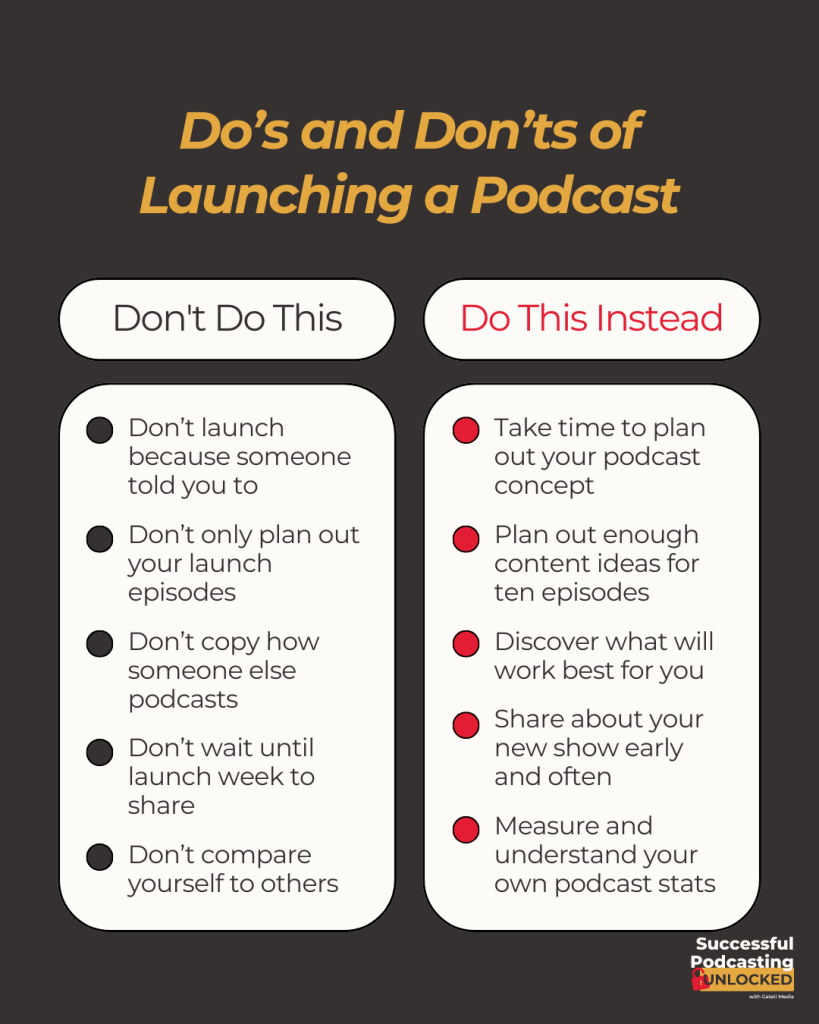
Top 10 Do’s and Don’ts for Launching Your Podcast

With over 50 podcasts launched in the last four years, we’ve seen quite a few do’s and don’ts for launching your podcast. 

If you’ve already launched your podcast, there are still going to be some tips and tricks that I’ll have for you. 

For those who are thinking about launching, or maybe are at the beginning of I’m about to launch, these are some things you will want to consider.

Time to get straight with what you should and shouldn’t do when launching your podcast!

And don’t forget to download our FREE Podcast Launch Roadmap + Workbook.

The Top Do’s and Don’ts for Launching Your Podcast

Today, I’m sharing some of the ways we’ve not only helped clients launch their podcasts but also launched our podcasts for Galati Media. 

We’re going to start with the don’ts because those are the ones that people are usually doing and then we’re going to talk about what to do instead.

Don’t: Launch Just Because Someone Told You To

I heard a few summers ago that there was a prolific business leader who told their audience, “If you have a business, you should have a podcast.” 

I actually disagree with that.

I don’t think that a podcast is the first thing that you should do. Nor do I think that every business owner should have a podcast, every business owner should have some form of content that they are creating to engage with their audience connect with them in some way, and educate them. 

A podcast is not always the best way for business owners to do that. How to decide if launching a podcast is right for you.

The thing about podcasting is that it is a long game, you are going to be creating content for a very long time. And you may not always see that return on your investment of time and effort right away. It’s important that you go into it knowing this is what you want to do.

Do: Take Time to Plan out Your Podcast Concept

So instead of just following along with what the big names are telling you to do, what you should do is do your research to see if podcasting is even a format that you enjoy. 

Do you enjoy going in front of a microphone and speaking into it? 

Do you feel that you would need it to be scripted? Or do you feel that you can go off the cuff? Would you be too distracted to go off the cuff?

Choose a podcast format that works for you.

These are all things that you have to consider. Even beyond that, doing podcast market research can help you determine whether a podcast is necessary for your ideal listener, clients, or content viewers.

Don’t: Plan for Only the Launch Episodes

I see people do this so often that they get really excited about the launch. They have the trailer, and they’ve recorded three episodes and they get ready to launch it. 

Then they scramble to have the episodes ready for the next week. 

Oof! Don’t let this happen to you. There are things you can do to ensure you feel equipped to move forward with your shoe. 

Do: Plan Out Enough Content Ideas for at least ten episodes

Instead, plan out at least 10 podcast episodes

That puts you past the seven-episode mark, which is where most people fall off. 

And if you’re feeling ambitious, you can decide on having a season’s worth so if you are doing your podcast in seasons then you have enough for your season or at least planned out enough

If you’re feeling really ambitious, you can also do 25 episodes, which is where the majority of people stop creating their podcast. 

Quote: Only 10% of podcasts make it to 50 episodes.

With that in mind, if you can reach 25 episodes, you are likely to have already created the processes needed to keep your podcast going through to 50 episodes. 

Remember, planning 25 episodes does not mean you must be locked into these ideas.  These are simply ideas for you to use as options for your podcast content.

Don’t: Follow Someone Else’s Format

I have several different types of podcasts that I have created over my time in podcasting. 

The Honest Product Bench (podfaded in 2019) was an interview and solo podcast. 

In 2019 I launched Two Sisters and a Cult (podfaded in 2021) with my sister and we never had guests on the podcast. 

Then I launched the Listeners to Leads podcast, which is more instructional and educational. I have regular guest episodes and have people share their podcasting experience. It’s more of a case study-style podcast. Then I intermittently do solo episodes that are educational and share my expertise. 

Finally, I launched Successful Podcasting Unlocked which gives my audience actionable tips they can achieve in 10 minutes or less. 

Each of my podcasts has been very different. It took time and effort to find a cadence and format that worked best for me.

Do: Take Time to Discover What Works for You

I found that all of these work best for me. I can create a podcast with any of these formats, but that doesn’t mean that it will work for you. 

And I didn’t know what would work for me when I first started podcasting. It took time for me to figure that out. 

I know that this can feel frustrating, because you might feel like you want to have this right the first time, but you’re not going to have it right the first time. 

Most likely, when you go back to listen to your initial podcast episodes, you won’t like them very much. And that’s okay. I don’t think anyone really likes those episodes very much.

Don’t: Share Only When You Launch

I’m going to put on my marketing degree hat for a second and get real. 

I see people try to do this in their marketing in general. They’ll tease that something exciting is coming but if you aren’t a well known brand with large pre-sales, this is not the strategy you shoul be using.

Do: Share it Early and Often

Instead, engage your audience with the podcast. 

Ask them which cover art they like best. 

Ask them which music feels like inspires them more for the topics, you can ask them. 

If you were to launch a podcast, which you are going to launch a podcast, what questions would you expect to be answered on that show? 

What kind of content would you expect to have? 

Or perhaps even what guests might they expect to see on your podcast? 

These are all ways to incorporate your audience and get them excited about what’s to come. 

If you’re only sharing about it the week of your launch, you’ll miss out on so many connections with your audience. 

Instead, promote your podcast at least a month ahead of your launch

Ask them what podcasts they listen to. 

These are all different ways to engage with your audience before you even launch. And before you have content for them to binge.

Don’t: Compare Yourself to Others

When we create a podcast or anything really, it’s very easy to get distracted by what other people are doing and the success they are having right away. 

Most often we compare apples to oranges when it comes to our podcast.

I promise you, that the success you see other people have will most likely not be your story. It will be incredible, but it won’t be identical.

Do: Understand Your Own Podcast Stats

Look at your stats, especially after that first three-month mark.

I actually don’t recommend looking at your stats before that point because it’s very easy to get distracted by those numbers. 

Instead, when you get to that three-month mark, review how you’ve done and then go from there. 

Don’t look at your friends or other podcasters. Only look at your numbers versus industry standards.

Did you know that if you get 40 downloads in the first 7 days an episode is live, that automatically puts you in the Top 50% of shows? (According to Buzzsprout Stats Jan 2024)

That is doable!

Learn to grow your podcast with these ten simple steps.

Why Do We Fall Into These Mistakes?

Believe it or not, it’s easy to make these mistakes. I see it happen all the time. 

But awareness is the first step. With these tips, you’ll be on your way to an incredible show!

I created this workbook to help you launch a strategic podcast.

Click here to download my free Podcast Launch Roadmap to get started today.


Galati Media
Privacy Overview

This website uses cookies so that we can provide you with the best user experience possible. Cookie information is stored in your browser and performs functions such as recognising you when you return to our website and helping our team to understand which sections of the website you find most interesting and useful.